True Financial

  • Home
  • My Prosperity Login
  • About
    • John Duncan – Fee Only financial planner
    • Fee for Service Financial Planning
    • Our Ideal Client
  • Advice
    • Benefits of Financial Planning
    • Cash Flow Management
    • Superannuation
      • What is Superannuation
      • What is a SMSF
      • Contributions Limits
    • Investments
      • Investment Philosophy
    • Insurance Advice
      • Insure The Stay-at-Home Parent
      • Income Protection Insurance
    • Retirement Planning
    • Estate Planning Advice
    • Business Advice
  • Articles
  • Video Library
  • Testimonials
You are here: Home / Articles

June 27, 2016 by John Duncan

Brexit Vote Reaction – Don’t React

On Friday we witnessed a significant event and its real time impact on financial markets. Britain voting to leave the European Union.

Despite a final week “Remain” rally that pushed up equities, commodities and the Australian dollar, someone was clearly reading the tea leaves the wrong way.Financial markets love certainty (Remain) while they hate uncertainty (Exit) and they certainly hate this outcome. However, this is just another bump (or dip) in the investing journey that will likely look remarkably benign when we look back on it in the years to come.

This decade, still living with the lingering aftereffects of the Global Financial Crisis, has seen several market shaking events. The Japanese Earthquake and Tsunami rocked world markets in 2011, while markets were less than overjoyed when the US had its AAA rating clipped by S&P later that year.

And just when investors have started to feel comfortable this decade, ongoing fears about China and Greece would rear their heads to unleash waves of volatility.

But… where was the worst place to be invested?

The old “safe haven” of cash of course.

Here’s $1 invested into the various asset classes from January 2010 until May 2016:

GOW1016

There are some rough moments in there, but Australian listed property leads the way with an annualised 13.60% return, while cash has returned investors an annualised 3.50%. Australian shares have managed an annualised 6.23% and International shares an annualised 11.91%. Anyone ignoring all the market shaking events along the way has inevitably done better than someone who kept themselves safe in cash.

Back to the Brexit.

There’s inevitably more uncertainty to come, but there are some things that are certain.

One thing not mentioned – the referendum isn’t legally binding in any way. The next step will be parliamentary politics. We’ll take up that part of the story from The Financial Times

The UK government could seek to ignore such a vote; to explain it away and characterise it in terms that it has no credibility or binding effect (low turnout may be such an excuse). Or they could say it is now a matter for parliament, and then endeavour to win the parliamentary vote. Or ministers could try to re-negotiate another deal and put that to another referendum. There is, after all, a tradition of EU member states repeating referendums on EU-related matters until voters eventually vote the “right” way.

Despite the celebrations and glum faces we’ll see in the media, Britain can’t just leave the EU tomorrow. The Lisbon Treaty demands a negotiating period with the European Council of up to two years.

Fortunately for markets and unfortunately for the exit voters that’s plenty of time for all manner of goodies and interventions to possibly convince the UK to stay… let’s wait and see..

This represents general information only. Before making any financial or investment decisions, we recommend you consult a financial planner to take into account your personal investment objectives, financial situation and individual needs.

Filed Under: Uncategorized

March 11, 2016 by John Duncan

Do Politics Matter To Investment Returns?

Do Politics Matter To Investment Returns?

If you’ve spent any of your time listening to talkback radio or reading discussions online you’ll know wading into politics can be a dangerous game. Hot-headed people escalate arguments at the drop of a hat over the fortunes or criticism of their side.
So when politicians wade into our own industry or our areas of expertise we tend to keep our commentary muted. Except to say despite their posturing, neither side knows much about regulating financial planning, and like everyone else who doesn’t own a crystal ball, politicians know absolutely nothing about economic & investment forecasting.

For the most part, beyond individual regulatory decisions for specific industries, politicians don’t have much of an impact on the wider share market or your returns if you’re properly diversified, yet it doesn’t stop investors wondering and politicians expecting us to believe otherwise.

The emergence of Donald Trump seems to have a lot of people nervous for various reasons and questions are being asked about any impact he could have on world markets. In a similar vein this week, government minister Peter Dutton told us “I think the stockmarket will crash” under Labor.

Like any good investment newsletter spruiker Mr Dutton didn’t offer any clear reasoning, but he did get his intended headline. Maybe Mr Dutton has another career in mind, selling gold or alternative investments, where he has to talk the sharemarket down, but in this instance he’s giving Labor too much credit.

Similarly, Donald Trump has many people spooked, ascribing doom scenarios to his potential ascension to the US Presidency given some of his statements. However, flick through Trump’s 1987 book “The Art of the Deal” and you’ll be reminded Trump prides himself on attracting attention and manipulating the media. He argues it is part of his business strategy because a newspaper column (good or bad) was always cheaper than advertising.

Furthermore, talk of Trump being a loose cannon starts to fall apart when he’s already assembled an advisory team comprising former New York Mayor Rudy Giulliani and two members of President Ronald Reagan’s administration. Trump might be successfully selling himself as an anti-establishment politician, but it’s more likely just another Trump sales tactic.

Bringing us to sharemarket returns under political parties since 1980. Firstly in Australia from the time each political party took office, as measured by the ASX All Ords Accumulation Index.

OZPoliticalReturns

There is an advantage to Labor on the chart, but no one could truly suggest either side played a significant part in the returns they enjoyed, or suffered, during their governance. Both Labor and Liberal had to deal with significant meltdowns on world markets that flowed into Australia and impacted our market.

In the US, from the time each President took office until they left, as measured by the S&P 500.

USPoliticalReturns

In the US the returns are quite impressive for both parties, with double digit annualised returns under Reagan, Bush I, Clinton and Obama. The only outlier is George W. Bush who suffered from the collapse of the dotcom bubble, a collapse of the housing market and a major terrorist attack on US soil.

You’d have to be overly partisan to draw investment conclusions from either of these tables, so we’d suggest not to worry about who is in charge and just vote for the old favourites – diversification, asset allocation and taking the risks that are historically worth taking.

This represents general information only. Before making any financial or investment decisions, we recommend you consult a financial planner to take into account your personal investment objectives, financial situation and individual needs.
Filed Under: Uncategorized

January 21, 2016 by John Duncan

Response to Volatility

21 January 2016

Ten years ago, in another country, a man we’ll call Bill, died at 75. He left his wife, a lady we’ll call Betty, $50,000 and a house worth $350,000. Betty was 65, living on a government pension and no longer wanted the hassle of the house. So she sold it, but before leaving she asked her next-door neighbour for advice on investing the proceeds.

Her neighbour pointed Betty towards his financial advisor. Soon Betty was set up with a portfolio that paid her rent and offered her income in addition to her pension.

Then 2008 happened.

Betty’s portfolio fell by 25%. Despite her funds still doing what they were designed for – paying rent and offering additional income, Betty panicked, ignored her advisor and sold at the bottom. She dumped the remaining cash into a savings account as the country’s central bank was slashing interest rates. Within a year the central bank had cut interest rates to almost zero.

Over the next few years Betty’s money sat in the bank earning next to nothing. The funds she cashed in recovered their losses and continued to pay distributions. Betty continued to make regular withdrawals from her cash, only they were smaller as she attempted to conserve her cash. Interest rates never recovered and now Betty’s withdrawals have nearly eaten away all her cash.

We tell this story because we’re all human and can be easily frightened. Markets have had an extremely poor start to the year and the media has piled on. The biggest headline recently came with the Royal Bank of Scotland telling investors to “sell everything”.

The strategist behind the call was Andrew Roberts. Roberts suggested we were in for a global deflationary crisis and warned investors to brace for a cataclysmic year. We’re not saying Roberts and RBS are wrong, because we don’t know what comes next, but few in the media offered any perspective to the call.

In 2010, after a rough start to the year, the same Andrew Roberts was quoted in UK’s The Telegraph:

“Andrew Roberts, head of European rates strategy at RBS, said “Great Depression II” could now be approaching” and “This is a global deflation scare.”

You may recall the sequel to the Great Depression never happened in 2010.

What to do about the current turmoil? It’s unknown if the share market will go down further before it goes up again, so the hardest thing to do is also the best thing to do – nothing.

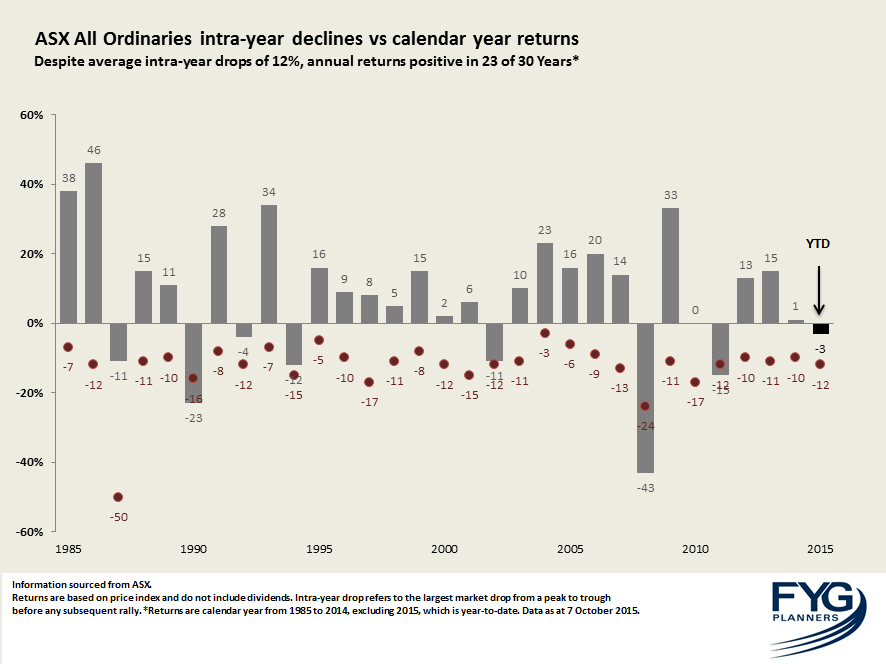
Andrew Roberts’ appeal to base emotions will resonate with many people, just like 2008 spooked Betty. They’ll believe this time is different and it’s time to bury their cash in a vegemite jar. The reality is this isn’t anything new; declines like we’ve seen in 2016 are an annual occurrence. Over the past 30 years the average intra-year decline on the ASX is 12%, and in 23 of those 30 years the market still finished the year positive.

If your portfolio is well diversified then you can weather these declines. Investors drawing income can do this from cash and defensive assets and rebalance their portfolios when share markets improve.

We ensure most of our clients in drawdown phase have at least 5 years of defensive assets available so that growth assets don’t need to be sold in a downward market. For clients in the accumulation phase of their lives, it is an opportunity to buy equity assets at cheaper prices.

Accumulators and investors with longer term investment strategies can accrue additional assets at lower prices or they can simply allow some time for their asset prices to recover.

As always still feel free to contact us if you have and questions on this or any other issue.

This represents general information only. Before making any financial or investment decisions, we recommend you consult a financial planner to take into account your personal investment objectives, financial situation and individual needs.
Filed Under: Uncategorized

October 23, 2015 by John Duncan

2015 Third Quarter Review

 2015 September Quarter Review

Economic Overview

The scale of China’s economic slowdown and the policy response to it were among themes that preoccupied global markets in the September quarter.

On August 11, China devalued its currency by nearly 2%, a move that fuelled concerned about the success of China’s efforts in rebalancing its economy from investments and exports to domestic consumption.

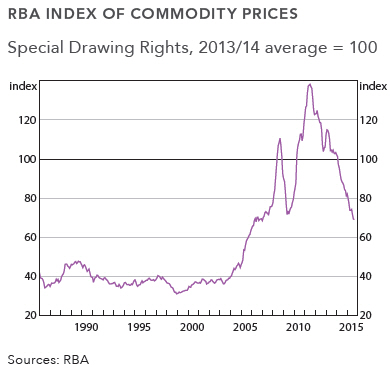
Given China’s substantial demand for iron ore, coal and other raw materials, concern about its slowdown was cited as one possible factor – alongside supply issues – in driving down commodity prices, resource stocks and related currencies like the Australian dollar.

In the US, China’s slowdown was cited by the Federal Reserve as they delayed an anticipated increase in interest rates. Despite this, Fed governor Janet Yellen said she still anticipated an increase before the end of the year. Central banks elsewhere also maintained accommodative interest rate policies for similar reasons.

Across the Atlantic, data showed a recovery in European business sentiment. In August, Greece, secured a third bailout from its creditors in return for promising to carry out economic reforms.

RBA Commodity Prices

Late in the quarter, the emergence of the Volkswagen emissions scandal raised concerns at the impact on the German economy. The car marker, whose CEO quit over the rigged emissions tests, is one of Germany’s largest employers.

In Australia, the commodity downturn hit resource companies and resource rich regions like Western Australia. With the economy slowing and inflation contained, the Reserve Bank kept the cash rate at 2%, where it had been since May.


Market Overview

Asset Class Returns

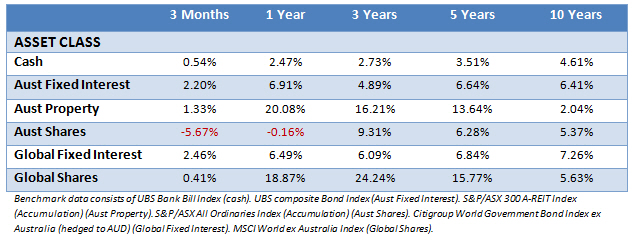
The following outlines the returns across the various asset classes to the 30th September 2015.

September 15 Returns

Global equity markets in the September quarter posted their worst quarterly performance in four years, led by emerging markets and more specifically commodity and energy related shares.

Exxon Mobil Chevron, Glencore and BP were among the biggest drags on global equity markets, though there were positive contributions from some technology and consumer names such as Amazon, Google, Facebook, Nestle and Nike.

Unsurprisingly the weakness spilled over into commodity related currencies, with the Brazilian Real, South African Rand and Australian Dollar among the worst performers against the US dollar.

Fading expectations for inflation made for good bond returns, with longer-dated government bonds posting their biggest quarterly gain of 2015, while the search for yield in a low interest environment helped to lift listed real estate. Again, more evidence of the benefit of diversification – as local shares sunk, other asset classes behaved in a completely different fashion.

On the Australian share market, energy companies like Santos and Origin were among the worst performers, though merger activity boosted some industrials like Asciano and Treasury Wine Estates. Qantas, continuing its turnaround and benefiting from low oil prices, posted strong gains.

In New Zealand, it was a similar story to Australia, as the local share market also posted its worst quarterly performance in several years, but NZ bonds posted strong quarterly gains.


Was there a time without volatility?

It’s been a volatile year, apparently.

The market has moved around quite substantially and the media has been on the scene to remind us about it. If there’s one constant that keeps the media in business it’s retelling an old story and trying to tell us it’s fresh and relevant – curse our short memories!

If we could remind ourselves how common and ultimately uneventful market volatility and most corrections are, we’d endure a lot less stress when investing. With that in mind, to highlight how the worst periods during a year are often markedly different from the whole year, we’ve put together a 30 year chart of the ASX highlighting intra-year declines vs. full year returns.

The message? Corrections happen regularly – but they’re rarely fatal.

Intra Year vs Calendar Year

This chart underlines the danger of reading too much into a temporary correction and taking action based upon it. Significant drops happen at least once on a yearly basis and if we take the worst declines (those included for this this chart), they average 12% down before the market forms any type of recovery.

There are a few things to note. Firstly, on three occasions the yearly return was worse than the worst intra-year decline measured. A 10% fall can happen in a short period of time; from there the market may form a small recovery or trade sideways over a number of months. From that point if it starts another fall it will inevitably drag the yearly return lower. Thankfully the fall/reprieve/fall scenario has only occurred three times in the last 30 years.

Secondly, even good years will suffer rough declines. 2012 and 2013 produced solid double digit returns, but at one stage during both of those years they suffered double digit peak to trough falls before recovery. And take 2009, as the world reeled from the financial crisis. The ASX had hit a double digit decline by early March, something that would have most investors questioning their strategy to stay the course, but from that point the market staged a remarkable recovery and finished the year 33% ahead.

If you’re a long term investor it’s just another reminder that there’s nothing to be feared from a correction.

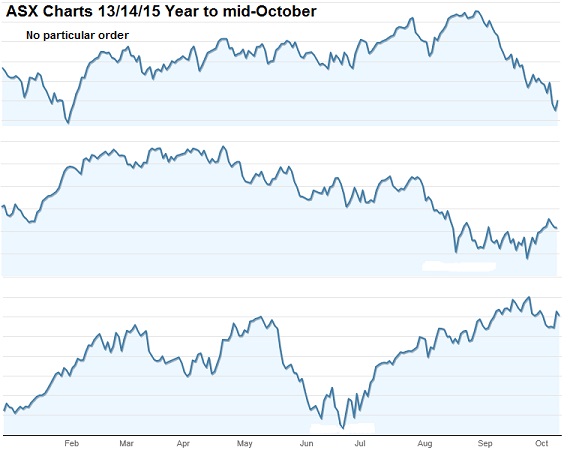
Now the following chart isn’t the art work of an indecisive snail that fell into an ink pot, it’s just further evidence volatility is nothing new. The combined lines are three ASX charts from 2013, 2014 & 2015. They are through till mid-October and the charts are deliberately untagged and in no particular order.

Despite the media playing on the idea that “volatility is back in 2015” it appears hard to identify any real difference in volatility between the three charts. Volatility has neither remerged, nor has it been absent in any of the charts. There are roaring ups and downs, with little smooth sailing to be found.

ASX 13 14 15

Has it really been a volatile year or just a normal one? In truth it’s been both – markets are always volatile and that’s normal.


With thanks to DFA Australia.

This material is provided for information only. No account has been taken of the objectives, financial situation or needs of any particular person or entity. Accordingly, to the extent that this material may constitute general financial product advice, investors should, before acting on the advice, consider the appropriateness of the advice, having regard to the investor’s objectives, financial situation and needs. This is not an offer or recommendation to buy or sell securities or other financial products, nor a solicitation for deposits or other business, whether directly or indirectly.

Filed Under: Uncategorized

July 28, 2015 by John Duncan

2015 – Second Quarter Review

Economic Overview

The global economic backdrop remained mixed in the June quarter. Continued recovery in the US and modest gains in Europe and Japan were offset by a continuing slowdown in China, weak commodity prices and Greece’s recurring debt woes.

Globally, monetary policy remains highly accommodative. However, the US Federal reserve has declared its intention to raise interest rates sometime this year if key indicators continue to strengthen.

Across the Atlantic, despite an easing of deflation fears and small signs of an economic recovery, the European Central Bank kept rates at record lows and continued its quantitative easing program.

In Asia, the economic news was also mixed. In Japan, business sentiment improved as the economy emerged from a recession trigged by last year’s hike in sales taxes. Meanwhile China grappled with slowing exports, manufacturing and its property market. In late June, China’s Central bank cut interest rates for the fourth time since November.

cmdpricesjun15

For Australia, the falling terms of trade and low growth in labour costs depressed incomes. The fall in mining investment, as major projects have come online, has yet to be replaced by new growth. Central banks in Australia and New Zealand were both torn between heated housing sectors and falling commodity prices, yet opted to cut interest rates to offset weakening overall demand.

Late in the quarter, Greece’s five-year-long debt crisis came to a head after the breakdown of marathon talks with its international creditors. The prospect of a Greek default unnerved markets and raised concerns of a break-up of the 19-nation Euro currency block.


Market Overview

Asset Class Returns

The following outlines the returns across the various asset classes to the 30th  June 2015.

returnsjun15


A strong start to 2015 for equity markets gave way to a more mixed picture late in the second quarter as attention moved to the prospect of higher US interest rates and the future of Greece in the Eurozone.

Despite the late June dip that dragged quarterly returns down, over the full financial year most asset classes delivered solid returns.

Currencies boosted unhedged global equity returns through the year as the $USD rose in anticipation of a US rate hike, though this effect waned in the June quarter.

Global indices ended largely flat for the quarter as the Greek debt crisis eroded gains towards the end of June. The UK was the top developed market in Australian dollar terms, while the US market was mostly unchanged.

Emerging markets were flat over the quarter, with small companies beating large and value companies beating growth. China was the standout market across the financial year, even with a heavy fall in June, the Shanghai Composite Index was still up over 150% for the year.

The Australian market lagged those offshore, dropping 6.5% for the quarter to reduce its full year return to 5.6%. Again, most of that damage was done in the last weeks of June as the market reacted to Greek debt, China’s share market tumbling and the RBA talking down interest rate relief.


That was a bad few weeks… or was it?

Q:  I am concerned at all the turbulence in the markets and wonder if I should move my share-based investments inside super to cash until things calm down.

That question was put to financial advice columnist Noel Whittaker on July 14. Noel offered an uninspiring one sentence response; so we thought we’d go into a little more detail and analyse the timeframe that inspired this question.

Due to Greek debt and Chinese gamblers, world markets suffered significant volatility across June & July. If you were just reading the headlines or heard general news reports when the media decided the sharemarket’s falls were big enough to warrant reporting on, you’d likely think it was a horrible span of a few weeks and investors were left significantly in the red.

You’d be wrong.

While the market falls came at exactly the wrong time for anyone using the end of the financial year as a measuring stick, 14 days into the new financial year and the market was actually higher than it was a month earlier – a time of relative calm when no one was yet talking about Greece!

While Greek’s debt saga could drag on further and China’s stock market gamblers could sell up when restrictions are lifted or get a second wind, this past month serves as an important lesson in how to handle volatility.

We’ve compiled a chart of the ASX All Ords from June 15 to July 15, we’ve then superimposed some headlines taken from the Australian Financial Review that highlight how quickly the media whips between light and dark stories, some amusingly timed. The chart also highlights the volatility a sharemarket can endure during a one month period (with some significantly down days); yet still end that month higher than it started.

If you expand the chart, you’ll note the warnings on Greece started 15 days before the deadline and become more apocalyptic as the 30th of June grew closer, aligning with the market declines. At the absolute bottom we were told “Greek saga set for a catastrophic turn” only to see the market race higher. At the next peak the headlines said “The Panic Has Gone – For Now” only to see the market take a large drop.

greechi

Many of the headlines appear to have awkward timing to them – seemingly relentless market declines are followed by headlines of more horror to come and at that moment the market sharply turns upwards. Or just when the headlines say “don’t panic” the market moves sharply downward.

If you truly want to get something out of this chart, we’d ask you to imagine yourself looking at the ASX close on June 15 at just under 5,500 points. Then imagine you went on holiday for a month to Tropical Island with no communications, meaning you had no idea what the market was doing. Then imagine you arrive home on July 15 to find the ASX close at just over 5,600 points.

Would anything that happened between those two dates have really mattered to you? And if you wanted to exit, when would be the right point to wait for calm to re-enter? As investors we need to remember short term sharemarket charts often appear as disconcerting as the period between June 15 and July 15, meaning there’s no chance of correctly picking “when things will calm down”.


With thanks to DFA Australia.

This material is provided for information only. No account has been taken of the objectives, financial situation or needs of any particular person or entity. Accordingly, to the extent that this material may constitute general financial product advice, investors should, before acting on the advice, consider the appropriateness of the advice, having regard to the investor’s objectives, financial situation and needs. This is not an offer or recommendation to buy or sell securities or other financial products, nor a solicitation for deposits or other business, whether directly or indirectly.

Filed Under: Uncategorized

July 3, 2015 by John Duncan

Greek Debt Not The Apocalypse

Greece and its debt obligations (and default) are back on the agenda in a big way and that means a whole host of experts are filling media air time and column space with what they think will happen next.

They don’t know, but they’ll happily tell you they do. If you’re in the market for a doom and disaster opinion there is no shortage of them. There will be volatility, but predictions of a financial apocalypse where Greece sets off a chain reaction that collapses other countries and ends with savings being confiscated are ridiculous.

The safest option, we’ve always found, is to use history as our guide.

You might be surprised to know a significant number of countries have defaulted on their debt over the years, but the two most notable in recent memory were Russia and Argentina.

In 1998 the Asian financial crisis combined with a decline in oil prices found Russia wanting and unable to pay its debts. Russia’s debt crisis, as with the current Greek crisis was playing havoc with world financial markets.

The months preceding Russia’s default knocked between 8-10% from world share markets, yet after the default happened, confidence appeared to return. Despite the default, Australia, the US and major international markets posted double digit returns for 1998.

Interestingly, after Russia defaulted, some foreign investors said they’d rather eat nuclear waste than buy Russian bonds again, yet a little over a year later foreign investors were back investing in Russian government bonds.

The key point here is when there is opportunity investors will move back in very quickly – as the oil price regained ground so did Russia’s ability to start repaying debts.

Three years after Russia defaulted, Argentina suspended payments on its $132 billion in debt in late 2001. At the time financial markets were still in the midst of shakiness after 9/11 combined with the dot-com bubble bursting, so it’s tougher to trace the impact of Argentina’s debt default, but it was some time in the making (similar to Greece). This meant many international lenders and investors had limited their Argentinian exposure.

Right now Greece is in default and waiting for a weekend referendum on accepting future austerity measures. There are still negotiations on new aid, payment extensions and debt restructuring in the works.

What happens next is anyone’s guess, but it’s meaningless for anyone building wealth for their life, retirement or children’s education. Expectations of volatility like this are built into portfolios according to an investor’s risk tolerance.

Financial markets have at least one correction a year and they all need a reason. At the moment Greece is it. The same media sources that never report on a 2% share market gain will lead their bulletins with a 2% fall and how many billions have been wiped off the market.

Some things never change.

This represents general information only. Before making any financial or investment decisions, we recommend you consult a financial planner to take into account your personal investment objectives, financial situation and individual needs.
Filed Under: Uncategorized

March 26, 2015 by John Duncan

Super for First Home Buyers

Is being able to withdraw Super for first home buyers a good idea?

Last year the independent senator from South Australia, Nick Xenophon raised a loopy idea that has long been an obsession of the real estate industry. Let first home buyers raid their superannuation to buy a house.

It didn’t grab a great deal of attention and it attracted mostly criticism. Given Xenophon enjoys an occasional populist thought bubble and lacks the ability to carry such a proposal through to legislation, it soon died off – until recently.

With the federal Liberal government struggling in the polls there have been some notable backflips and populist ideas emerging. Xenophon’s superannuation raid for homes was recently reheated by Treasurer Joe Hockey. Given Hockey’s position in the government it attracted significantly more attention and unfortunately somehow legitimised the idea as being worthy of debate.

A similar idea was introduced in Canada back in 1992. Called the Home Buyers Plan, it was suggested to the then Canadian government by the Canadian Real Estate Association during a real estate downturn! First home buyers in Canada are allowed to dip into their Registered Retirement Savings Plan (RRSP) up to $25,000 (increased from $20,000 in 2009) for a deposit on a first home.

The money is meant to be repaid to the RRSP over 15 years, but in 2011 and after $28 billion in withdrawals, the Canada Revenue Agency reported 47% of the people who borrowed the money had never paid back a cent.

When the money is not repaid, a tax deduction previously given for those RRSP contributions is then whacked back onto the individual’s taxable income. So the first home buyer then has an empty retirement account and a larger tax bill! So why would these first home buyers increase their tax bill rather than replenish their retirement account?

Probably because they don’t have the money.

Looking at Canada’s housing market we might be able to understand why. According to the real estate boards of Vancouver and Toronto it now takes over $1 million to buy a house in either city. A situation even worse than Melbourne or Sydney.

canushouse

And as the graph above shows, Canadian national house prices (the red line) have continued to power upwards becoming more unaffordable since 2009 when the Home Buyers Plan withdrawal limit was increased. Meanwhile in the 3rd quarter of 2014 Statistics Canada announced Canadian household debt had reached an all-time high.

It seems ridiculous for governments to encourage raiding retirement savings to bid up home prices and further indebt ourselves, but let’s look at how it affects a retirement scenario.

Assume two 30 year olds with a 35 year superannuation timeframe. They both have $25,000 in their superannuation account and they’re both currently earning $50,000 per annum, meaning a $4750 yearly super contribution. Over 35 years we’ll assume continuing employment and an annual pay rise of 2%, compulsory employer contributions stay at 9.5% and they make no additional contributions.

The first 30 year old does not take the$25,000 out of their superannuation to buy a house. If we assume a 7.5% average annual market return, their superannuation balance grows to $1,226,997 over 35 years. The second 30 year old does take the $25,000 out of their superannuation to buy a house. Assuming the same market return, their superannuation balance grows to $912,775.

So there’s an over $300,000 or 25.6% difference in final returns.

Pandering to the current angst of first home buyers over rising house prices in some cities may be a popular move in some circles, but it appears extremely short sighted.

Firstly, it hurts the retirement incomes of those who raid their superannuation and may mean they’re drawing a government pension when they previously wouldn’t. Secondly, you never make anything more affordable by throwing money at it. Like with the first home owners’ grants, sellers will see first home buyers coming and adjust their prices upward accordingly.

After all, ask yourself why the program in Canada was suggested by the Canadian Real Estate Association during a market downturn and why it was increased during the financial crisis in 2009 – it certainly wasn’t to push prices down.

This represents general information only. Before making any financial or investment decisions, we recommend you consult a financial planner to take into account your personal investment objectives, financial situation and individual needs

Filed Under: Uncategorized

February 6, 2015 by John Duncan

Five Investment Rules to Remember

The world’s in a mess! Oil’s tanked. Greece and the European Union are fighting over debt (again). Australia has a Prime Minister hanging on by the fingernails (again). The Australian dollar has cratered against the US. Madmen are running riot through the Middle East (again). Interest rates have been slashed in Australia and all over the world because economies are shaky.

In summary, things have never seemed so uncertain – as usual.

If you’re worried about this mess, remember, despite the endless headlines, those with a balanced and liquid portfolio continue to do quite well.

Some investment rules to remember for the year ahead (and always).

1. Prepare to be surprised. Rarely do we make it through a year without a calamity that will have an effect on markets somewhere. So don’t exit an asset class. This year, like last year (and the last hundred or so), was meant to be end of days, but the recent interest rate cut put a fire under local shares.

The dollar drop also improved returns on unwedge international shares. Who knows what comes next? The point of having a well-constructed portfolio is having various asset classes weighted in line with your risk profile because the future is a guess and you prepare your portfolio for it now.

2. Don’t try to time the market. For the past few years experts have told us why various markets and asset classes will crumble. If you listened, you left those freely available gains on the table for someone else. It’s better to be invested for the long term than paralyzed each day by the latest headline.

Markets will eventually take some time off, but no one knows when. And even when they do, most asset classes will continue to pay you to hold them with ongoing distributions.

3. Don’t buy individual shares. While the local market has raged upwards to its highest point in years, anyone who had filled their portfolio with individual energy or commodity companies was still licking their wounds. It’s an amateur mistake.

Looking for hot tips is time consuming and haphazard. And waiting for great news on one company to fire up your portfolio is true risk. Especially if the market leaves you behind as you twiddle your thumbs waiting for a big announcement.

4. Understand what good returns are. Red hot real estate has been a media go to. Stories of baby boomers piling in with their SMSFs and Chinese buyers flooding auctions are regularly reported in the media as the market heated up, but how hot is the real estate market?

Real estate stats firm RP Data released Australian real estate returns from the beginning of 2009 until the end of 2014 and they ranged from impressive – Sydney up 57% and Melbourne up 50% to more pedestrian – Brisbane up 9% and to Hobart, where prices haven’t moved in six years.

Yet the return on Australian shares over the same period was 90%. Australian listed property returned 93% and unhedged global shares returned 79%. As listed assets experience a minute by minute test of their valuation we get to read headlines like “$50 billion wiped off the market” twenty times a year. This spooks some investors and you’ll find them swearing their investment property can’t be beaten for growth.

5. The economy isn’t the share market. Interest rate cuts signal things aren’t so rosy. When it comes to private debt – a real drag on consumer spending, only in Canada and that other bastion of great financial management, Greece, do households carry more debt than Australia. Yet studies have shown a low correlation between GDP growth and market performance.

Quality companies will make money in good times and bad. And many companies listed on the ASX conduct their business overseas or are US dollar exposed. A falling dollar is better for their returns. There are winners and losers from every economic reality. And the true winners stay diversified and liquid.

This represents general information only. Before making any financial or investment decisions, we recommend you consult a financial planner to take into account your personal investment objectives, financial situation and individual needs.
Filed Under: Uncategorized

January 23, 2015 by John Duncan

2014 Year End Review

Economic Overview

Divergence in economies and markets was a major theme for investors in 2014, alongside geopolitical tensions and sliding commodity prices.

With US activity picking up, the US Federal Reserve ended its quantitative easing program and signalled potential interest rate rises in 2015. An increase in US interest rates would be the first move since 2008, although it said it would exercise patience.

Meanwhile, Europe and Japan looked to be heading back down the deflationary tunnel. With deflation shadowing Europe, the European Central Bank contemplated its own quantitative easing program, boosting the US dollar. Similarly, in Japan, the economy slipped into recession and Prime Minister Shinzo Abe unveiled another $30 billion stimulus package.

yearinnewsdec2014

The above chart tracks the performance of the Australian share market over 2013 against some of the major news events of the year. These headlines are not offered to explain market returns. Instead, they serve as a reminder that investors should view daily news events from a longer-term perspective, and avoid making investment decisions based solely on the news.


In China, industrial activity eased and the property market slowed. By November the People’s Bank of China responded by cutting interest rates for the first time in two years. The impact of slowing Chinese steel production and rising supply hit the iron ore price hard. By the end of 2014 the iron ore spot price had lost nearly 50% in US dollar terms.

Oil was a major story. The price ended the year down 45%, with the majority of those losses in the last quarter. Supply was the driver, with US unconventional wells being the world’s new production source in recent years. In response, OPEC vowed to not cut production to accommodate higher cost US oil at its November meeting.

At home, the falling iron ore and coal prices hit Australia hard, dampening incomes and punching a hole in the federal budget. With inflation subdued and the unemployment reaching 12 year highs the Reserve Bank continued to leave interest rates at record lows. With the US dollar rising and commodity prices falling, the Australian dollar fell heavily.


 Market Overview

Asset Class Returns

The following outlines the returns across the various asset classes to the 31st  December 2014.

assetclassreturnsdec14


Equity markets diverged significantly over the year, reflecting in part the fortunes of the underlying economies. The US, China and India were some of the strongest market performers, while oil dependent Russia was at the rear.

In the December quarter the US S&P 500 hit record highs, registering its eighth consecutive quarter of growth to end the year 24% higher. In Europe the picture was less bright. Major indexes finished the year off in sluggish fashion, just as they began it.

After a double digit negative first quarter, Japan’s Nikkei strengthened thanks to a weakening Yen and further stimulus expectations. Meanwhile in China, the Shanghai Composite went into overdrive finishing the year with a 45% surge in the final quarter.

With the commodity boom continuing to recede, resource exposure was a drag on the Australian market. Consequently, total gains (price and dividend) were modest at just over 5% with a strong final quarter helping to erase the third quarter correction. The top performers came from the healthcare and telecom sectors. Somewhat making up for equities was the impressive double digit returns from Australian listed real estate, again highlighting the benefit of diversifying across asset classes.


asxannualreturnsdec14


The Australian’s Dopey Picks

Last year at this time we brought you the story of how The Australian newspaper’s top stock picks for 2013 had fared. To refresh your memory, it was extremely poor:

Of The Australian’s 66 “top share picks” for 2013 there were 31 winners and 35 losers. The average gain on the winners was 30% and the average loss on the losers was -43%. The average return from all picks combined was -8.86%. A staggeringly bad result when the ASX 300 was up 14.65% which meant this collected wisdom from The Australian’s “industry experts” underperformed the market by over 20%.

The Australian had another list for 2014, but before we get to it, The Australian’s own poor share picking didn’t deter it from wading into a late year discussion on Australian National University (ANU) announcing its intention to divest some energy and resource companies from its investment fund. In an editorial, The Australian criticised ANU for “poor judgement” and “dopey stock picking”.

With that sort of bravado we assumed The Australian was on track for a stellar year with its picks in 2014. Then we tallied them up…

dopeypicksdec14

Out of the 65 share picks The Australian offered up for 2014, there were 22 winners, 42 losers and one company that closed the year at the same price it opened. From the 22 winners there was an average return of 41.12% and from the losers there was an average loss of 34.26%.

The average return from all 65 picks was a loss of 8.21%, while the ASX 300 (price only) lurched to a 0.83% gain. So again, The Australian’s picks again underperformed the market significantly; only in 2014 it was slightly less embarrassing because the market didn’t set the world on fire.

However The Australian’s consistency in posting negative returns should serve as another warning to those taking their cues from media investment tips. No matter the market conditions, The Australian’s returns were awful. In 2013 when the ASX 300 posted double digit returns The Australian’s tips finished in the red and in 2014 when the ASX 300 struggled to a positive return, The Australian’s tips again finished in the red. It seems they’re all conditions failures!

This is also a reminder that true diversification isn’t achieved by holding a large amount of shares in one country. It’s achieved by holding a number of funds, spread across asset classes, throughout the world. Once you’ve set up a portfolio like that, there’s no need to look for new share tips each year.


With thanks to DFA Australia.

This material is provided for information only. No account has been taken of the objectives, financial situation or needs of any particular person or entity. Accordingly, to the extent that this material may constitute general financial product advice, investors should, before acting on the advice, consider the appropriateness of the advice, having regard to the investor’s objectives, financial situation and needs. This is not an offer or recommendation to buy or sell securities or other financial products, nor a solicitation for deposits or other business, whether directly or indirectly.

Filed Under: Uncategorized

November 12, 2014 by John Duncan

2015 Recession “Predicted”

“Predictors of 1929 crash see 65% chance of 2015 recession” that headline made an appearance on The Age and Sydney Morning Herald websites this week. Early on Tuesday it had low prominence, sitting midway down the page, but by about 3pm it had been moved to sit just below the sites’ mastheads.

The internet allows real time reader measurement. Moving the story up the page suggests the interest in the story must have been high. In fact, the story was really taking off everywhere around the internet. And it was a very catchy headline. Some people who predicted the 1929 crash forecast a 65% chance of a recession in 2015. Who wouldn’t read that?

And a 65% chance, no less! We’re grateful they were able to be so precise.

Digging into the story we find Jerome Levy was a guy who flogged his stocks before the crash of October 1929 and these days has a forecasting institution named in his honour, The Jerome Levy Forecasting Center.

Sadly Jerome’s no longer making predictions because he died in 1967. Luckily, his grandson David has seemingly inherited the family forecasting gene and is the one talking bad times for 2015.

David predicted the last financial crisis, which lends some authority to his calls and makes those headlines even more frightening, but in all of those stories telling of the wondrous Levy family forecasting, there were a few dud calls missing. They acknowledged Levy’s previous call of a 60% chance of a US recession in 2011:

“Conditions around the world look progressively more worrisome, and Washington seems to be gradually shifting its focus away from fiscal stimulus toward deficit reduction,” Levy said. “The prospects for a U.S. recession next year have edged up from a toss-up to around 60%.”

The US grew at 1.7% in 2011. So that prediction didn’t turn out, but the media left a few other clangers on the sidelines.

In an awkward piece of timing Levy gave an interview to Barron’s in 2009 where he talked of asset values continuing to contract and multiple recessions ahead. The date was March 9. For those who don’t remember, that was the exact day share markets around the world hit bottom and the bear market ended.

Finally, in an interview with Bloomberg at the end of 2012 Levy said it was time to be defensive. Yet by the end of 2013 Australian shares were 19% higher and global shares were up 48%.

See how this forecasting game works? Get a couple of notable predictions right and the media will keep giving you attention because you “might” be right in the future. They’ll even ignore most of your misses because it ruins the entertaining part of their story. And while today’s media might forget the litany of dud predictions out there, thankfully they’re being preserved by a thing called Google.

This represents general information only. Before making any financial or investment decisions, we recommend you consult a financial planner to take into account your personal investment objectives, financial situation and individual needs.

Filed Under: Uncategorized

  • « Previous Page
  • 1
  • …
  • 3
  • 4
  • 5
  • 6
  • 7
  • …
  • 9
  • Next Page »

Keep up to Date

Powered by VMA-Emailer

Meet John Duncan

John Duncan - Financial Planner

Director for True Financial - John Duncan - Fee Only financial planner To receive the best financial planning advice you need the best financial planner. John Duncan is certainly in that category. John is a financial planner who is unique in not only his high level of knowledge and experience in financial planning but also in the amount of areas that John advises in. A Financial Planner with a strong Education background John is a Certified … Read More

Post Categories

  • Budget (5)
  • General (27)
  • Insurance (2)
  • Investment (14)
  • Property (5)
  • Superannuation (4)
  • Tax Tips (7)
  • Uncategorized (50)

Like us on Facebook

Recent Posts

  • 2025 Q2 June Quarter Review
  • Don’t Vote with your Portfolio
  • Investing Has Been Solved
  • John Hussman: Man Who Predicted…
  • Bank Runs

Privacy Statement

See our Privacy Statement here

Keep up to Date

Powered by VMA-Emailer

True Financial is an Authorised Representative No. 428771 and Credit Representative No. 428873 of FYG Planners Pty Ltd, AFSL/ACL No. 224543. ABN 29 009 541 253

Contact Information: Address: 23 Errard St Kelvin Grove 4059 - Phone: (07) 3169 2570 - Email: admin@truefinancial.com.au - Web Design & SEO by: Visual Marketing

Information provided on this website is general in nature and does not constitute financial advice. True Financial Pty Ltd will endeavour to update the website as needed. However, information can change without notice and True Financial Pty Ltd does not guarantee the accuracy of information on the website, including information provided by third parties, at any particular time. Every effort has been made to ensure that the information provided is accurate. Individuals must not rely on this information to make a financial or investment decision. Before making any decision, we recommend you consult a financial planner to take into account your particular investment objectives, financial situation and individual needs.True Financial Pty Ltd does not give any warranty as to the accuracy, reliability or completeness of information which is contained in this website. Except insofar as any liability under statute cannot be excluded, True Financial Pty Ltd, its employees do not accept any liability for any error or omission on this web site or for any resulting loss or damage suffered by the recipient or any other person. Unless otherwise specified, copyright of information provided on this website is owned by True Financial Pty Ltd. You may not alter or modify this information in any way, including the removal of this copyright notice.
Manage Cookie Consent
To provide the best experiences, we use technologies like cookies to store and/or access device information. Consenting to these technologies will allow us to process data such as browsing behavior or unique IDs on this site. Not consenting or withdrawing consent, may adversely affect certain features and functions.
Functional Always active
The technical storage or access is strictly necessary for the legitimate purpose of enabling the use of a specific service explicitly requested by the subscriber or user, or for the sole purpose of carrying out the transmission of a communication over an electronic communications network.
Preferences
The technical storage or access is necessary for the legitimate purpose of storing preferences that are not requested by the subscriber or user.
Statistics
The technical storage or access that is used exclusively for statistical purposes. The technical storage or access that is used exclusively for anonymous statistical purposes. Without a subpoena, voluntary compliance on the part of your Internet Service Provider, or additional records from a third party, information stored or retrieved for this purpose alone cannot usually be used to identify you.
Marketing
The technical storage or access is required to create user profiles to send advertising, or to track the user on a website or across several websites for similar marketing purposes.
Manage options Manage services Manage {vendor_count} vendors Read more about these purposes
View preferences
{title} {title} {title}