True Financial

  • Home
  • My Prosperity Login
  • About
    • John Duncan – Fee Only financial planner
    • Fee for Service Financial Planning
    • Our Ideal Client
  • Advice
    • Benefits of Financial Planning
    • Cash Flow Management
    • Superannuation
      • What is Superannuation
      • What is a SMSF
      • Contributions Limits
    • Investments
      • Investment Philosophy
    • Insurance Advice
      • Insure The Stay-at-Home Parent
      • Income Protection Insurance
    • Retirement Planning
    • Estate Planning Advice
    • Business Advice
  • Articles
  • Video Library
  • Testimonials
You are here: Home / Archives for John Duncan

July 16, 2025 by John Duncan

2025 Q2 June Quarter Review

Economic Overview

Tariff concerns initially ruled the roost in Q2 2025, before somewhat fading into the background. In contrast to Q1, there was a strong bounce for stockmarkets, as President Trump’s announced tariffs quickly became suspended tariffs. Again, raising the question, are President Trump’s tariffs actually about tariffs, or in some cases, are they leverage to secure other outcomes favourable to the US? The bluster and then delay of tariffs in some instances has prompted the acronym “TACO” (Trump Always Chickens Out), however some allies are starting to heed Trump’s calls for higher defence spending. While tariffs bubbled in the background for most of the quarter, the focus turned to interest rates again and the sustainability of the debt load the US is carrying. Despite a sharp “liberation day” tariff dip, the Australian dollar continued to strengthen against the US dollar throughout the rest of the quarter as US debt came into focus. Debt and the “one big beautiful bill” also caused a split in the eventful Donald Trump/Elon Musk friendship. Q2 was another favourable one for emerging markets as weakness in the US dollar provided a welcome tailwind.

In the US, GDP came in at an annualised rate of -0.5% for Q1 2025, the first negative figure since 2022. While this was weaker than initially expected, due to some revisions in consumer spending and exports, the largest contributor to the negative number was due to surging imports (which subtract from GDP). The increase in goods imports, up 38%, occurred due to concerns around tariffs. Business was madly stockpiling inventory ahead of anticipated tariff announcements. Consumer spending grew by 0.5%, the slowest rate since Q1 2019. As expected, federal government spending decreased by -4.6%, the largest fall since Q1 2022. Conversely, fixed investment increased by 7.6%, which was the largest increase since mid 2023.

Some trade news came in June, first a deal with the UK confirmed mid month, and in late June the US and China confirmed a trade framework to allow rare earth exports and easing of tech restrictions. Progress with other trade partners, the EU and Japan specifically, remained uncertain with a July deadline for the 90 day postponement of reciprocal tariffs. This uncertainty is likely to hinder GDP growth in the coming quarters.

The labour market has remained resilient despite policy uncertainty. There are several reasons for this. Some companies are adopting a “no-hire, no-fire” approach due to market tightness, the strength in consumer spending, and the performance of the defense and health care sectors. Another 147,000 jobs were added in June, with the unemployment rate slightly lower at 4.1%.

CPI came in at 2.4% in May, slightly up on 2.3% in April, which was the U.S. economy’s lowest inflation figure since February 2021. Regardless of the measurement, core or all items, it’s still persistently above the Federal Reserve’s 2% target level, however, transportation services and shelter, have declined significantly. These are typically sticky categories, and have kept inflation elevated even as goods inflation has continued to ease over the past year. The Fed maintained its target rate at 4.25% to 4.5% for the fourth consecutive meeting. This pause, following three rate cuts in late 2024, indicates the Fed is vigilant about potentially resurgent inflation while keeping an eye on broader economic conditions, along with the uncertainty of tariffs, which would apply upward pressure on prices and hit growth.

Other points of US interest during the quarter: the “one big beautiful bill” which caused the one big split between Donald Trump and Elon Musk. The bill includes several provisions that will affect the economy for years to come. The most significant are the extension of personal tax cuts from the 2017 Tax Cuts and Jobs Act. While the administration plans to offset revenue losses with cuts to health care and nutritional programs, environmental tax credit reforms and tariff revenues, the Congressional Budget Office estimates the bill will increase the federal deficit by $3.4 trillion over the next decade. Moody’s also downgraded the US credit rating during the quarter, making it the last major ratings agency to remove the Aaa rating.

By June, US housing inventory had increased by 27.7% over the previous year. This was the 83rd consecutive week of inventory growth and the highest percentage increase since the housing bubble back in 2006. While for sale signs have been increasing, many homeowners have been holding off selling due to ultra-low mortgage rates they secured during the pandemic. Selling would mean a new mortgage at 6% to7%. Finally, the dollar experienced a large sell-off in April due to uncertainty surrounding US policymaking, with the US dollar index down 10.7% for the year.

Source: RBA 2025

In the Eurozone, the European Central Bank cut interest rates twice in the period, by 0.25% each time. ECB President Christine Lagarde said that the central bank had “nearly concluded” its rate-cutting cycle. Eurozone CPI decreased to 1.9% year on year in May 2025, down from 2.2% in April and below market expectations of 2%. This is the first time inflation has fallen below the ECB’s 2% target since September 2024. This was influenced by a sharp slowdown in services inflation, which dropped to 3.2% from 4% in April, the lowest level since March 2022. Eurozone Manufacturing PMI moved higher to 49.5 in June, up from 49.4 in May. While a positive, a figure below 50 still represents a contraction, and PMI has been in contraction for some time now, but the figure has been consistently inching back toward 50 throughout 2025. There was also further progress in Q2 regarding Europe increasing its defence spending. While the US has been pushing for a 5% of GDP target, NATO offered 3.5% of GDP on “hard military”, with an additional 1.5% for infrastructure related spending to accommodate military convoys and movements. Cybersecurity and advanced tech for weapons would also fall under the 1.5%.

In the UK, the Bank of England cut interest rates by 0.25% to 4.25% in May, despite inflation remaining above the bank’s 2% target. Inflation came in at 3.4% in May according to the Office for National Statistics. The UK economy expanded 1.3% year-on-year in the first quarter of 2025, against 1.5% in Q4. The services sector grew 1.4%, with construction growing 1.2% while the production sector stalled. On the expenditure side, household spending rose 0.9% while business investment spiked 6.1%. The ongoing economic and social malaise in the UK has been evident in political polling since the last national election, with the governing Labour party and the Conservative opposition both on the nose. In May, voters took their cricket bats to local council elections, with Nigel Farage’s Reform Party winning the most seats, 41% of the 1641 seats available, and taking control of a number of local authorities. The Labour Party and the Conservative Party saw historic losses of their vote share.

In Japan, Q1 GDP came in at 1.7% on an annual basis, but was flat 0%, on a quarterly basis, though this was ahead of a forecast -0.2%.  Private consumption was revised slightly higher to a 0.1% gain for the second consecutive quarter, reflecting government efforts to cushion the impact of rising food prices, specifically rice and higher energy costs. Business investment strengthened, expanding 1.1% and up from 0.6% in the last quarter, while government spending fell by -0.5%, marking its first decline in five quarters. Inflation remains persistent, hitting a more than two year high, with core CPI up 3.7% in May, and well above the BoJ’s 2% target.

In China, GDP growth for Q1 came in at 1.2%, making it eleven consecutive periods of quarterly growth. The year-on-year figure for Q1 held at 5.4%, which was above market expectations of 5.1%, showing Chinese growth has been resilient, mostly stemming from productivity improvements and rising consumer spending.  Obviously, some of the bigger news for the quarter revolved around trade and tariffs. US imports from China dropped to $24 billion in April, this was the lowest since 2010 if the early pandemic months are excluded. Ongoing trade tensions and higher tariffs will continue to affect external demand. Although tensions have eased, tariffs on Chinese imports to the U.S. will remain higher than at the start of the year. For its own part, China has started to exempt a quarter of US goods from tariffs, with a list of exempted products circulating in early May. The People’s Bank of China reduced borrowing costs by 0.1% in May to help offset the impact of new US tariffs.

In Asia (ex-Japan & China) and Emerging markets, the quarter saw a sharp jump in the Taiwanese dollar, which was partly a result of exporters selling some US dollar assets. Core inflation held above 5% in Brazil during Q2, while year on year GDP was down to 2.9% in Q1 vs 3.6% in Q4 24. The Central Bank of Brazil hiked its Selic rate by 0.25bps to 15% at its June meeting, this followed a 0.50% hike in May. The board cited persistent inflation, but signaled this may be the last hike in the current cycle, which has seen rates move up 4.5% since September 24. Year on year GDP growth in India came in at 7.4% for Q1, significantly up on the 6.4% figure of Q4 24, as lower food and energy prices, along with improved eased benchmark interest rates helped growth. Indian CPI eased for the seventh straight month, down to 2.82% in May. In South Korea, political instability subsided following the election of a new president in June,  Democratic Party candidate Lee Jae-myung.

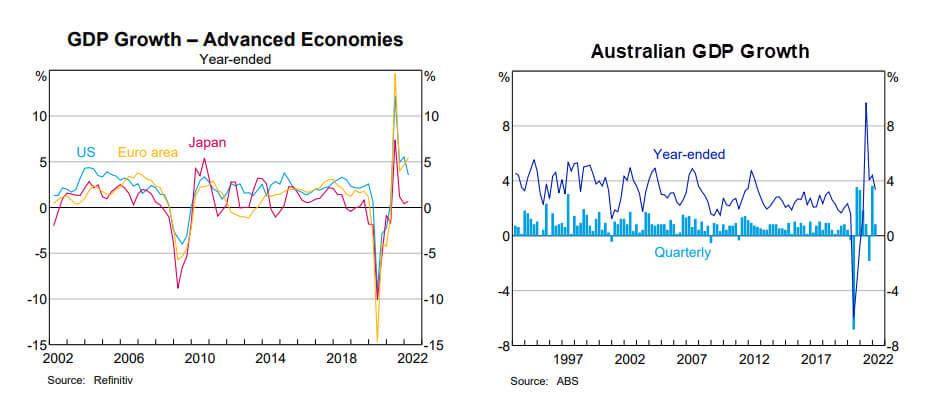
Back in Australia, data released in June showed GDP increasing by 0.2% for Q1 2025. Year on year GDP growth end of Q1 sat at 1.3%, the same as the prior quarter, but below expectations of 1.5%. GDP per capita, noted as a proxy for living standards, went back into negative territory, sliding -0.2% for the quarter, and -0.4% year on year. Inflation increased 0.9% in Q1 2025 and came in at 2.4% for the 12 months ending March 25, and above expectations of 2.4%. The April and May 25 monthly figures came in at 2.4% and 2.1% respectively. Food and non-alcoholic beverages slowed to their lowest movement in five months, at 2.9%, as there was a significant slowdown in fruit and vegetable prices. Inflation eased for housing at 2.0%, and for recreation and culture at 1.4%. Inflation accelerated for alcohol and tobacco, clothing inflation also increased, while health at 4.4% and education at 5.7% were steady.

The RBA cut rates following its April meeting, and in its statement noted “the risks to inflation have become more balanced. Inflation is in the target band and upside risks appear to have diminished as international developments are expected to weigh on the economy.”

As always in Australia, an interest rate cut was immediately taken as a positive for real estate, and auction clearance rates saw a jump. House prices increased in every market over Q2 25, except for regional Tasmania. The combined capitals were up 1.4% and combined regionals were up 1.6% for the quarter. Sydney was up 1.1% for the quarter and up 1.3% annually, according to Cotality (formerly CoreLogic). Darwin 4.9%, Perth 2.1% and Brisbane 2.0% saw the largest increases over the quarter. On an annual basis, Adelaide was up 8%, with Perth and Brisbane both up 7%. Melbourne was the only capital to go backwards on an annual basis, down -0.4%. While rent increases continued to ease across the quarter on a national basis, up 2.7%, the majority of capitals were well ahead of that figure. Darwin at 6.2% led the way, with Hobart at 5.3% and Perth at 4.9% showing the strongest growth in rents. Melbourne at 1.2% and Sydney at 1.9% saw the most subdued growth.

On the people vs shelter issue, Cotality noted “dwelling approvals remain 23.9% below the 20,000 a month required to meet the national housing accord targets.” And while rolling net long term and permanent arrivals (or new people in the country) were edging downward throughout 2024, since January 25 that has reversed. The number sits well above 400,000 net new arrivals annually. This makes a mockery of the treasury budget forecast of 260,000 for 24/25. Notably, the annual net rolling figure pre covid was never above 300,000. Since mid 2023 it’s never been below 400,000. The Australian government continues to talk about the importance of increasing housing supply at the same time it continually, and quietly, increases the demand for housing.


Market Overview

Asset Class Returns

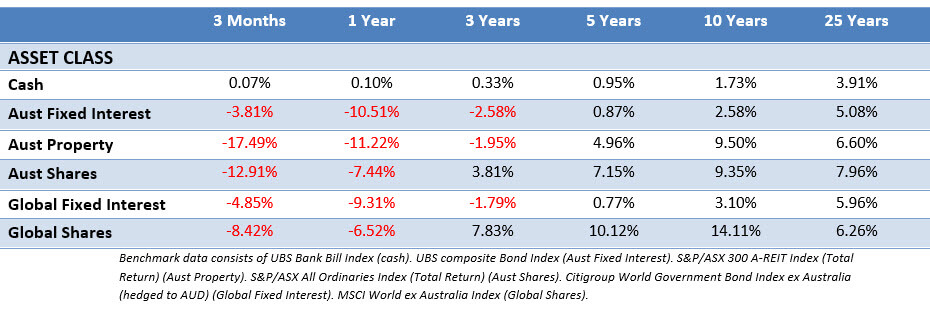
The following outlines the returns across the various asset classes to 30 June 2025.

Global stocks saw a healthy bounce across the board in Q2. Currency markets were volatile, with the Australian dollar falling sharply against the USD as the quarter began, but it quickly bounced, before strengthening through the rest of the quarter. At the same time the AUD slightly weakened against the Euro.  MSCI World ex Australia (Hedged) was up 9.45% for Q2, while the unhedged index was up 5.94%. US large caps were up 10.94%, while US small caps climbed 8.50%. MSCI World Ex US in USD was up 12.03% for the quarter, and year to date is ahead of the S&P 500 by 11.70%.

The Australian stockmarket sprang back to life, while Australian listed property was back in the green, up 13.4% after two consecutive quarterly losses. Bonds were influenced early by tariff concerns, but mostly depended on the decisions of Central Banks. In the US where the Fed was on hold, the 10-Year US Treasury yield was flat across Q2, inching from 4.21% to finish at 4.22%. US 2-year Treasury Note yields edged downward during Q2, from 3.89% to 3.72%. In the UK, the 10-year Gilt yield fell from 4.68% to 4.48%. In Australia the 10-year yield saw some sharp intra-quarter movements as it slipped from 4.39%, to finish at 4.17%. While the 2-Year government bond yield slid from 3.68%, to finish at 3.22%.

In the US, there were decent gains led by info tech and communication services as investor appetite for some of the Magnificent 7 stocks reignited. Again, stocks with exposure to artificial intelligence saw a recovery after weakness earlier in the year. US stocks were also supported by corporate earnings for Q1, which were generally robust. The underperforming sectors were healthcare, down -7.8% and energy down -8%, with the Trump administration seeking to lower drug prices in the US, which put pressure on some healthcare companies.

In the Eurozone, stocks posted decent gains broadly in Q2 with the MSCI EMU up 4.95% in EU terms and now up over 12% for the year. In France, however, the CAC 40 slipped -1.6%, while the German DAX was up 7.87%. Industrials and real estate sectors were the strongest performers. Within industrials, it was defence stocks continuing their good performance, as an agreement at the NATO summit for countries to lift defence spending ensured interest in the sector continued. Consumer discretionary, healthcare and energy were the strugglers.

In the UK, the FTSE All-Share moved higher. With the best performing sectors being industrials, telecommunications, utilities and real estate. The large cap FTSE 100 was up 2.07%, but the strongest performers were the small and mid-sized companies which bounced strongly after an underwhelming Q1. The mid cap FTSE 250 was up 11.04%, and UK small caps were up 10.38%. The underperforming sectors were mostly energy and healthcare, both having a larger exposure in UK large caps, which explains the performance difference by size.

In Japan, The Japanese stockmarket was up in Q2, with the broad market TOPIX Index up 7.3% in yen terms. The Nikkei 225 outperformed the TOPIX, up 13.67% as large caps bounced back after a weak Q1. As elsewhere, market sentiment was weak initially as the Trump Liberation Day announcement of “reciprocal” tariffs hit, but then quickly improved after positive developments in trade negotiations with China and other key partners. Many Japanese companies released full-year results and provided guidance for the fiscal year ahead. While earnings forecasts were cautious, shareholder returns via dividend increases and buybacks rose significantly. Corporate governance reforms and efforts to enhance return on equity further underpinned the market’s performance during Q2.

Asia (ex-Japan) and Emerging markets were healthy in Q2, with MSCI AC Asia ex Japan Index up 6.77% in Australian dollar terms, while the MSCI Emerging Markets Index was up 6.49%. South Korea posted double-digit returns as political instability subsided, while strong gains were also made by Taiwan as it continued to benefit from optimism about artificial intelligence. India underperformed as expensive valuations weighed on the market. China posted a small positive return over the quarter, as the early part saw escalating tariff threats between the US and China, which eventually subsided with a more conciliatory mood between the countries. The Saudi Arabian market struggled as geopolitical tensions in the Middle East took their toll. Despite concerns about an energy shipping disruption, that provided a brief oil price spike, an oversupply of oil ensured prices closed down at the end of the quarter.

In Australia, the ASX 300 was up 9.48% in Q2, with every sector in the green except for materials, down -0.36% as the big miners were down slightly for the quarter. The leader was information technology, up 26.87% as Wisetech bounced after its Q1 selloff, Xero also saw a healthy price appreciation. Financials, up 15.67%, and communication services up 14.08% were the other outperformers. Along with materials, utilities, healthcare and consumer staples were the strugglers, but the trio did manage a gain, unlike materials. The financials result was heavily influenced by Commonwealth Bank continuing to scream upward and hitting a new record high during the quarter. This has pushed the bank’s yield down towards 2.5%, and well out of the “dividend darling” category. Some have questioned its lofty valuation as the most expensive bank in the world. Australian Super has taken a position to be underweight CBA, which caused its own performance to lag other superfunds for the financial year. Finally, the ASX Small Ordinaries was up 8.62% for Q2.


This material is provided for information only. No account has been taken of the objectives, financial situation or needs of any particular person or entity. Accordingly, to the extent that this material may constitute general financial product advice, investors should, before acting on the advice, consider the appropriateness of the advice, having regard to the investor’s objectives, financial situation and needs. This is not an offer or recommendation to buy or sell securities or other financial products, nor a solicitation for deposits or other business, whether directly or indirectly.
Filed Under: Uncategorized

March 21, 2025 by John Duncan

Don’t Vote with your Portfolio

The recent re-emergence of market volatility has stoked some fears. Specifically in the investors who take their politics a little too seriously.

Financial markets moving around is nothing new, but some investors, without a coherent investment philosophy, are quite happy to replace it with an incoherent politico-investment philosophy. Whatever happens in financial markets can be directly attributed to their political side or their political opponent.

This position makes investing incredibly difficult. Every time a government changes, it means their portfolio’s structure is up for consideration. The long term only exists if their team is in charge. If the other team is in charge, well, there may not be a future to look forward to!

There’s a not too surprising divergence right now in the US. The reaction to the recent market correction has split down political lines. Recently, both the New York Times and Wall Street Journal ran articles on investor reactions to the tariffs, the White House incident with President Zelenskyy, and the subsequent market sell off.

The Democrat voters had seen enough. It was the beginning of the end; they wanted to protect their money and were selling out. Move to cash and bonds. Risk off. The Republican voters and Trump supporters thought it was the complete opposite. This was just a regular market movement we see every year, nothing out of the ordinary. Keep buying stocks. Risk on.

It’s a very familiar story and something we highlighted in June last year, albeit with a role reversal, when Joe Biden was President. 67% of Republicans thought the US was in a recession, 80% of them believed inflation wasn’t easing, and 49% of Americans also thought the S&P 500 was negative for the year. At that point in time, it was actually up 15%. It wouldn’t be a stretch to assume most of that 49% were Republicans and Trump supporters. Now people drawn from that same pool of voters are relaxed about a market correction!

The people profiled in the recent New York Times and Wall Street Journal articles were as follows:

Yoram Ariely, retired with no noted affiliation, hadn’t changed anything in years, but last week sold half his stocks, fearful of all the changes.

Patton Price, who voted for Kamala Harris, liquidated his retirement accounts the day Trump was inaugurated.

Jasmine Singh, no noted affiliation, started selling US stocks and buying European stocks after the contentious White House meeting with Volodymyr Zelensky.

Francisco Ayala, a financial adviser, gave the example of two clients. One, who couldn’t stand Trump, was asking about investing outside the US. Another, who adores Trump, suggested this was just the way markets work.

Ben Pfeiffer, a Trump voter, started buying various stocks as they dropped. He thought the left or liberal side of politics had a bleak view, and it was making them vulnerable to bad decisions.

Lars Staack, a retired 62-year-old former Republican voter, but a democrat since 2016. A long-term investor in stockmarket index funds, he started selling out in January, switching much of the money into bonds, he now only held 30% in stocks.

Siegfried Lodwig, no noted affiliation, 80 and retired, had half his retirement savings in stocks, which was managed by an investment firm. He wasn’t planning to make any changes, suggesting the market always bounces back.

Praisely McNamara, who voted for Kamala Harris, withdrew half, which was the maximum amount allowable, of her 401.k (retirement savings) in February, despite having to pay thousands in tax penalties!

Alison Greenlaw (a friend of Ms. McNamara), no noted affiliation, liquidated her diversified target date retirement fund, to put it in a money market fund in late February. She suggested the uncertainty in the US was “existential”.

Stephen Dinan, a Democrat voter, moved his children’s education funds from US stocks to international stocks and bonds, while he switched, he and his wife’s retirement savings into bonds.

In several of these cases, it’s investors decades away from retirement making decisions that are being influenced by their political leanings and what they’ve seen on the news. The commonly accepted wisdom of doing nothing, no longer applies they say. They all believe we’re in uncharted territory. We’d say the future is no more uncertain that it’s every been. It’s the future, you can’t see it, so it’s always uncertain!

In the cases of Siegfried Lodwig and Lars Staack, Mr Lodwig is an advised investor who sounds reasonably relaxed, with half his portfolio in stocks. Probably around what it should be for his age of 80. On the other hand, Mr Staack appears to be DIYing and is not relaxed. He now has only 30% of his portfolio in stocks, and at 62, is considering lowering that even further.

Which is another notable point here. The advised person is already in the right portfolio and is not doing anything. Most of the non-advised people are reacting. Specifically on Mr Staack, it appears he entered retirement very aggressively, with his portfolio 100% in stocks. He has shifted from that extreme to an underweight position of 30% in stocks, and has a view to lowering that allocation even further. Without any guidance he’ll probably continue to fiddle with his portfolio until he feels things are “certain”. That might be when a Democrat is back in the White House!

As Mr Staack admitted in the article, “I’m fumbling about, trying to figure out what is going to be the best way to preserve my retirement savings.”

We could say there’s a better way, but sometimes political leanings are too much to overcome.

Take the case of Michael J. Boskin, a professor of economics at Stanford University and a senior fellow at the Hoover Institution. He chaired the Council of Economic Advisers under President George H.W. Bush. Boskin was out early in Barack Obama’s first term as president proclaiming that the performance of the stockmarket in the first 7 weeks of his presidency was evidence sinister stuff was afoot.

It’s hard not to see the continued sell-off on Wall Street and the growing fear on Main Street as a product, at least in part, of the realization that the new U.S. president’s policies are designed to radically re-engineer the market-based U.S. economy.

Boskin’s editorial in the Wall Street Journal asserting Obama’s policies were further crashing the US stockmarket was published on March 9, 2009. That’s a notable date many investors have committed to memory. It was the date the stockmarket bottomed in the US during the global financial crisis!

The S&P 500 was up over 15% per annum over Barrack Obama’s Presidency.

Finally, if anyone might have an opinion about what’s going on in the US, it’s the US Federal Reserve who met this week. From Bloomberg:

For weeks the US economic picture has been darkening. If Wednesday was an opportunity for Federal Reserve Chair Jerome Powell to raise the alarm, he took a hard pass.

Speaking to reporters following a two-day meeting of policymakers, Powell downplayed mounting growth concerns and the price hits that could be on the way from President Donald Trump’s aggressive trade war. He even revived a once-abandoned term to say the inflationary impact of tariffs is likely to be transitory.

Doesn’t sound like a concern.

This represents general information only. Before making any financial or investment decisions, we recommend you consult a financial planner to take into account your personal investment objectives, financial situation and individual needs.

Filed Under: Uncategorized

March 28, 2024 by John Duncan

Investing Has Been Solved

A few years back, entrepreneurial guru Tim Ferriss, had the author and documentary maker Sebastian Junger on his podcast. Junger, who has taken plenty of risks in his career, including spending substantial amounts of time embedded with US soldiers in Afghanistan, was asked by Ferris what advice a 70-year-old Junger would offer to his current self.

Junger offered the following:

I think I would say to myself that the world is this continually unfolding set of possibilities and opportunities. And the tricky thing about life is, on the one hand, having the courage to enter into things that are unfamiliar. But to also have the wisdom to stop exploring when you found something that’s worth sticking around for.

The courage to enter/wisdom to stop dilemma is one we’ll all face as it applies to many areas of life. All our critical decisions. Opportunities, either taken, or not taken. Will this new thing prove fruitful and rewarding, or is it wise to remain with what you know and has proven satisfying? It’s particularly relevant when it comes to careers, business, or money.

As advisers we see the impact that financial changes and optimisation have on peoples’ lives. It does take courage to walk in the door of a financial adviser and be prepared to delegate your affairs. It’s unfamiliar, but so are most financial decisions. Courage is required to take any new financial decision because the unknown means some won’t work out for the best. It’s hard to be wise when you really don’t know.

One of our Canadian peers, Ben Felix has often stated he believes “investing has been solved”. And he’s right. As Felix further adds, “it’s solved because capturing market returns using low-cost funds is a close approximation of optimal.” The one caveat? He says, “it’s not easy because people are not wired for long-term thinking.”

Not wired for long-term thinking simply means behaviour problems. It could be the extra cash an investor left accruing in their account because they thought a correction was due, meanwhile the market’s gone up 15%. It could be an investor feeling the temptation of a hot stock, market sector or new fad. It could also be not accepting the reality that investing has been solved, simply because someone believes “times have changed”. Behavioural problems impede wisdom.

The worst outcome from accepting investing is solved? Very simply, an investor achieves a market return, relative to the risk taken according to the asset allocation of their portfolio. Nothing more or less. Historically, and over the long term, it’s proven a reliable way to build and preserve wealth. It just required that wisdom to stop exploring and settle on that consistent set of beliefs.

The worst outcome from not accepting this reality? It’s a haphazard approach to investing. There might be astronomical rewards, but they will be accompanied by an ever-present spectre of ruinous consequences. Many alternatives are speculative without any track record. Investing this way might feel more courageous because everything is unfamiliar, but wise is another matter.

Without consistent beliefs, these investors are subject to influence. There are many investment, political, and societal commentators who grab attention by casting doubt over what’s solved. They cast doubt over data. Over reliable strategies. Over tax advantaged savings systems. Over long established investment product providers. They cast doubt over governments and their intent for our money.

It all adds up and creates an environment of distrust. This often favours speculation, unproven alternatives and even frauds. We regularly see news reports highlighting millions, tens of millions, hundreds of millions or billions being lost by investors for various reasons. The numbers are so astronomical they often appear ridiculous. They also don’t register because they’re aggregate figures without faces accompanying the losses.

And the investors getting cooked like ducks aren’t the ones who believe investing is solved.

As part of the sentencing of Sam Bankman-Fried of FTX infamy, US Federal prosecutors released a collection of direct messages to Bankman-Fried’s X account (formerly twitter). These were sent from desperate investors who had money with FTX. Victim impact statements to the judge have also recently been released.

The messages to Bankman-Fried are immediate and panicked. Some are pleading, but others are more resigned to their fate. They all understand the gravity of their money vanishing. The victim impact statements detail what that money was and what it would have become. There’s no panic. They’ve lived with this for some time. Several of them were in life circumstances that shouldn’t have been associated with financial extremes. Disabilities, health challenges, caring roles. All their plans had been derailed and they’re demanding to be made whole.

It may seem ludicrous that someone can assume and even claim they had certainty in this situation. In some cases, it wasn’t just play money, whole life savings were sitting on an offshore platform that didn’t have US financial reporting requirements and they were invested in various cryptocurrencies and tokens that are extremely volatile. But set aside how much they’ve discounted risk and just consider the impact.

Their financial resources were wiped out, along with any assumptions they had about the future. On a personal level, every one of those stories will always be a tragedy.

Financial and investment loss, or exposure to fraud, is always more than just a dollar figure or trust erased. It’s holidays not taken, cars that aren’t upgraded, housing renovations not done, educations that are downgraded, relationships that are stressed, medical care that’s delayed, lifestyles that go backwards. Opportunities that are lost and may never be seen again. People become smaller and they live life with less joy.

Such things need serious consideration if someone decides investing hasn’t been solved. If they’re being more courageous than wise. What did that money take to acquire? What’s the likelihood it could be acquired again if it was wiped out? How desperate would they feel? How do plans and assumptions change without that money?

The solved option, a low cost, globally diversified, market-based portfolio doesn’t come without the prospect of loss. In the short-term fluctuations should be expected, but if capitalism continues to work as it has over the past century, such a portfolio should be able to right itself and prove rewarding over the long term.

Something that’s worth sticking around for. We just need to accept it.

This represents general information only. Before making any financial or investment decisions, we recommend you consult a financial planner to take into account your personal investment objectives, financial situation and individual needs.

Filed Under: Uncategorized

February 9, 2024 by John Duncan

John Hussman: Man Who Predicted…

There’s a never-ending cast of characters out in the world who have big opinions on the direction of financial markets. They might run their own newsletters or even their own funds. A number of them are permanently bearish. It’s a way of life and they can’t see things any other way (or their wallets don’t allow them to). They do fill a niche, milking unfortunate souls of their cash or delivering them returns that can only be defended if those souls exist in a permanently dark headspace where the end is always around the corner.

It would be fine if these people toiled away in obscurity, but our media has a feverish addiction to finding the most titillating forecasts. It then shines them into the sky, like the signal used by the Gotham City Police Department to attract Batman’s attention when they need his help. The only difference is the media are trying to attract the average investor’s attention, without any virtuous intent. The most eye-catching market stories always revolve around massive market falls.

Because these people may have once correctly forecast an outcome, that’s seen as credibility enough to publish their forecasts evermore. Over the past few months some of these characters have again been platformed by the media, but things have become much more extreme. Of course there’s noted kook, Rich Dad Poor Dad author, Robert Kiyosaki who is now forecasting the biggest crash of all time. Kiyosaki used to forecast crashes that never happened on a yearly basis, but now he has a twitter or X account, he’s now doing it every few months.

Not to be outdone, another noted doomer, Harry Dent has also predicted the “crash of a lifetime” amounting to an 86% fall in the S&P 500. Dent has a very patchy record on forecasting. In 1999 he predicted a boom, but ran into the dotcom crash. In 2009 he predicted a depression, which never happened. Dent does have a very good record attracting media attention and selling “end of days” books. This time Dent has threatened to quit forecasting if he’s wrong. Fingers crossed.

The last to step up to the plate is John Hussman. Hussman’s noted for picking the declines of 2000 and 2008. He’s said he’s not making a forecast, but he wouldn’t be surprised to see a near term market decline over 10% and a longer-term decline of up to 65%. Unlike Kiyosaki and Dent, Hussman has some skin in the investment game as an investment manager. That could be viewed as admirable, or disreputable, given he’s managing other people’s money.

Hussman is a former economics professor at the University of Michigan, with a Ph.D. from Stanford. Smart guy. And it’s worthwhile noting, at one point, Hussman had a track record of some distinction. During the 90’s he ran a newsletter and if his forecasts about disaster weren’t exactly on the money, his stock picking was impressive. His calculated returns regularly trounced the market and was often quoted in investment columns. Buoyed by his newsletter stock picking success, in 2000 he became a fully fledged investment manager, starting Hussman Strategic Growth Fund.

Hussman started off impressively. His Strategic Growth Fund’s only negative year for the 2000’s was 2008. And that was a very respectable -9.02% when the S&P 500 was down -38.62%. He significantly outperformed over that decade. This set the stage for Hussman to be listened to, often quoted, and presumably able to attract plenty of money from investors looking to invest with such a genius.

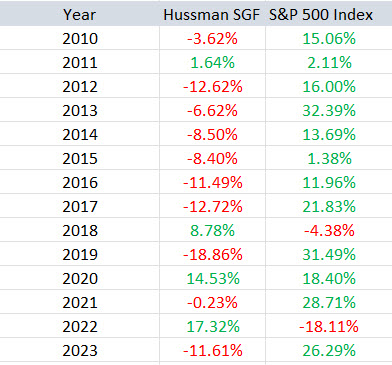
Unfortunately, as is so often the case with people who’ve correctly predicted something, or shot the lights out with outstanding performance, it’s a one off or they can’t maintain it. Across the 2010’s Hussman’s Strategic Growth Fund had two positive calendar years, and he’s had four positive years in fourteen.

The following table lays out the stark reality of Hussman’s performance since 2010.

But the media keep putting Hussman’s name up in lights. Just this week the Australian Financial Review’s Chanticleer column was reasoning that Hussman’s views are worthy of attention. Their caveat? Hussman’s recent five-year performance wasn’t great, but he was the guy who predicted 2000 & 2008! It wasn’t just five years of underperformance, they failed to acknowledge Hussman’s performance has been shameful for 14 years.

To be fair to Hussman, it appears he doesn’t go seeking out attention for his views. He merely publishes what he thinks on his website and the media pillages it and disseminates it to a wider audience. They’re always sure to mention “this is the guy who predicted 2000 and 2008” to make it seem more compelling. What they always leave out is Hussman is also the guy who called for massive crashes in 2013, 2014, 2015, 2016, 2017, 2018, 2019… you get the idea.

On the more realistic side, Hussman said he wouldn’t be surprised to see a 10% decline in the near term. We don’t disagree. It’s not a revelation because it’s almost an annual occurrence. As the following chart shows.

Hussman’s ongoing analysis of what he thinks will happen and why things didn’t turn out like he expected, reads well. He’s got very intelligent sounding arguments, with rational analysis, and it’s all very seductive. Then he starts attaching them to monster crash and economic depression calls, the likes of which have only been seen once since 1926. That was back when policy makers and central banks were less likely to intervene, and stockmarkets themselves didn’t have circuit breakers. But tales of these outcomes appeal to some.

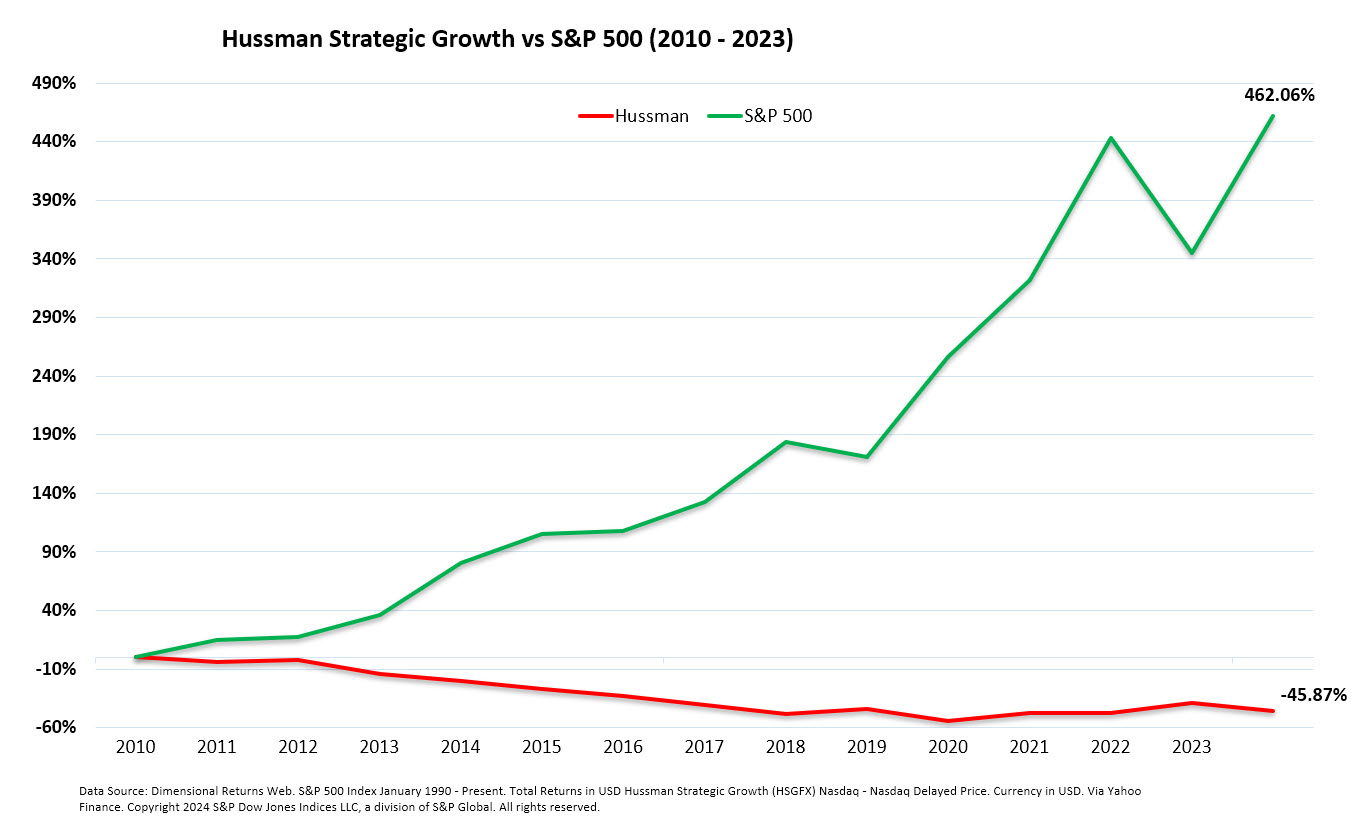
This is the saddest thing about these types of forecasters. They’ll all have their believers and defenders who’ll be willing to accept “it’s just the timing that’s off”. Someone who has invested with John Hussman over the past decade or more will likely never catch up what’s been lost, even if a massive crash did occur. As the cumulative growth of the S&P 500 and the cumulative loss of the Hussman Strategic Growth Fund shows.

Imagine you were in the red line for the past 14 years. You’d be wrecked.

With billions of people coming together on a daily basis to trade on financial markets, maybe the collective wisdom of the market knows better than any single one of us what it’s doing.

This represents general information only. Before making any financial or investment decisions, we recommend you consult a financial planner to take into account your personal investment objectives, financial situation and individual needs.

Filed Under: Uncategorized

March 24, 2023 by John Duncan

Bank Runs

The 18th president of the United States and the Commanding General of the Union Army, Ulysses S. Grant, spent the final year of his life in a desperate race to write his memoirs. Complaining of a sore throat in the summer of 1884, Grant delayed seeing a doctor until mid-autumn where it was confirmed he was suffering from throat cancer.

Grant completed his memoir on July 5, 1885, and died five days later. The book was a financial and critical success. Thanks to a 70% royalty contract offered by Mark Twain, Grant’s widow received around $450,000, a considerably large sum of money for the 1800’s.

What prompted this race against time? Grant was broke and feared leaving nothing for his wife. Surely, such a notable person would have accumulated some wealth into his seventh decade? Yes, but Grant had invested $100,000 into a brokerage run by his son and his business partner, Ferdinand Ward.

Unfortunately, Ward was a scoundrel and running a ponzi scheme through the brokerage. Happy with their initial returns, the Grants’ due diligence was sorely lacking, and when Ward told Grant Sr they were experiencing some funding difficulties, Grant borrowed another $150,000 to keep the business going. It failed regardless, setting off a financial panic which prompted bank runs and failures across New York.

As this short slice of history illustrates, bank runs aren’t new, or even rare in the US. There have been over 450 bank failures since 2008, with 2018, 2021 and 2022 the only years in recent memory not to see a bank failure in the US. Back a little further, during the savings and loans crisis of the 1980’s and 90’s, over a third of savings and loans associations went under.

Back then it was a combination of poor risk management, deregulation, and fraud. The 1980’s was characterised by high inflation and swift increases in interest rates. Many savings and loans institutions had issued a lot of longer-term fixed rate loans that ended up being lower than the cost the institutions could borrow at, and they couldn’t attract enough savings to cover shortfalls.

In the case of the Silicon Valley Bank collapse seen in recent weeks, the bank had put cash into longer term bonds at low rates which then lost value when interest rates sharply increased. When depositors came calling, there wasn’t going to be enough money to pay them out. Another risk was it served a specific industry with large deposits. The news spread fast among the tech industry that confidence was gone and money was being withdrawn, meaning the bank was terminal very quickly.

The other two banks that failed in the US, Signature and Silvergate, were both friendly to the cryptocurrency space. There have been suggestions that regulators had no problem closing the banks as a warning to other banks to keep away from cryptocurrency business. Investors can come to their own conclusions, but it may highlight how governments view cryptocurrencies.

At Credit Suisse, confidence had been low for some time. It had been hit hard by losses suffered through the collapses of Archegos Capital Management and Greensill Capital. Ongoing speculation saw many wealthy depositors pull money and deposits fell 40% last year. When its largest shareholder, the Saudi National Bank said they weren’t tipping more money in, it became a code red situation and $10 billion in deposits were pulled last week. While the Swiss National Bank was prepared to provide liquidity, regulators pushed the other notable Swiss investment bank UBS into acquiring Credit Suisse to stem further problems and restore confidence.

Confidence means a lot in banking.

Confidence also means a lot in financial markets. Things that seem unusual occurring in financial markets can prompt some concern. What should investors do in response? As always: nothing. Sometimes that’s easier said than done, but having some knowledge at hand is always useful. Here are some things to know and understand.

Rough Financial Conditions Mean Bad Returns?

Not necessarily.

One thing worth remembering is riding out a concern or crisis can mean decent returns over the long term. The issue is investors may have to take a few kicks in the teeth to get those returns. Discipline and patience are essentially a mouthguard that allows an investor to stay in the game. Not wearing a mouthguard often means an expensive lesson, sitting out the second half of the game when the returns show up.

The 1980’s are an example. They were chaotic. Inflation was high. As noted, the US was going through the savings and loans crisis. There was a recession in the early 80’s across much of the west. The S&P 500 in the US had a return of 12.45% per annum after inflation for the 1980’s. Like any other decade there were rough periods and 35% of months in the 80’s saw a negative return, but that’s quite common.

In Australia the ASX All Ords delivered a 9.39% per annum return after inflation for the 1980’s. As in the US there were rough periods, with 35% of months also in the red.

It’s important to highlight the negative months so investors are aware, but on the flip side, 65% of months were positive across the 1980’s. That’s where the growth comes from. Waiting and being there for the majority of months in a decade that are positive.

The Guy Who Predicted the Last Thing

The moment there’s some market volatility or the hint of something serious afoot in the financial world, eyes quickly turn to someone who might have predicted something previously to see what their insights are.

The problem is all these people are akin to the boy who cried wolf. The wolf turned up one time, meaning they got one forecast right and they’ve continued to dine off it with further crisis predictions. Unlike the fable, no matter how many times these people cry wolf, the media still platform them and plenty of people still listen to them.

Assuming motives are pure when there is money to be made can also be a mistake. Attention doom can pay well. Giving speeches to financial institutions, industry bodies and investment conferences is often an unseen, but lucrative business. Quite often someone is trying to get headlines for whoever has them speaking that month or a product they’re launching.

Then there’s those who may have a trading position they want to pay off. The case of hedge fund manager Bill Ackman during the initial Covid outbreak illustrates this. Ackman famously phoned into CNBC, in tears, suggesting hell was coming and the USA would cease to exist. No surprise Ackman was short the market at the time and betting it would fall. Arguably, his whole goal was to incite further panic to ensure his trades paid off.

Ackman’s hedge fund made $2 billion from the market falling during the initial panic, before promptly changing his position and buying stocks again. During the Silicon Valley Bank failure Ackman appeared on social media proclaiming regional American banks were all potentially on the brink. After his Covid performance, many speculated Ackman was again playing an underhanded game to spook investors and ensure his trades paid off. His true intent will be revealed next time his hedge fund reports. Unfortunately, there’s no way of dealing with people who want to shout “FIRE!” for their own benefit.

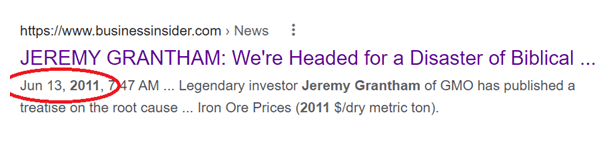
Our suggestion to deal with such predictions is google. You can take the power back and check out someone’s record. Enter their name and various years and see what comes up. They’ll likely have a record of misses or dubious behaviour going back years.

Finally, remember the majority of market selloffs start outside the financial world. A volcano in Iceland, airplanes hitting tall buildings, a war, an earthquake, a tsunami, a nuclear reactor melts down, a pandemic. No one forecasts those.

The Crisis Vacuum

One of the strange things that occurs with a predicted crisis, potential crisis, or actual crisis, are the assumptions that are made about it. There have been a lot of doomsday scenarios made over the years and they often leap from a potential problem directly to the forecast disaster. The assumption is any potential problem will occur in a vacuum. Problems will begin, and continue to cascade, while those with any influence will remain hands off and won’t lift a finger to respond.

The actions of Central Banks and large commercial banks in the US and Switzerland in the last few weeks underline how wrong this is. Problems weren’t left to fester. Swift action was taken and those in charge will continue to ensure liquidity and support is available in the system.

A notable example of vacuum and response was Kerry O’Brien interviewing economist Steve Keen on The 7:30 Report in October 2008. Keen laid out how bad he thought things were: Australia was on the brink of disaster and the housing market was in trouble. It formed the basis for O’Brien’s interview with PM Kevin Rudd on the program the following night. O’Brien was wound up about the state of the world economy and the frightening implications for Australia, peppering Rudd on national TV with Keen’s concerns about debt levels and the housing market.

Two days later the government announced a bank wholesale funding guarantee and a deposit guarantee. The next week they announced a large stimulus package focused on pensioners, families and first home buyers. Steve Keen is often derided as a fool in real estate circles because none of his doomsday scenarios came true, but ironically, he may have played some role in ensuring the government acted swiftly to ensure his predictions didn’t come true!

Are You Covered?

Australia’s Financial Claims Scheme covers amounts up to $250,000 held in authorised deposit taking institutions (ADIs). A list of ADIs can be found here. One thing important to note is what constitutes an ADI, for example Westpac also has St.George, Bank of Melbourne and BankSA operating under its license. If someone has one million dollars split evenly between those four banks, only $250,000 would be covered because it is considered one ADI.

This would be a consideration in the event of a property or asset sale. Someone may have well above the $250,000 limit sitting in cash for a period, so knowing where that money is and isn’t covered will be important.

Non-bank lenders are another consideration. These are not ADIs and do not take deposits, but they may offer an “offset account” type product attached to a mortgage. For anyone who has a mortgage with a non-bank lender and has money sitting in one of these “offset accounts” it’s important to read the fine print regarding these products. One non-bank lender’s “offset account” is accompanied by the following disclaimer:

Please note the ‘offset’ is a sub-account of the loan and not a separate deposit account. As such, the funds in the ‘offset’ are not covered by the government guarantee for deposit accounts.

Cash within superannuation is another consideration. This may be the first time you have heard this, but cash sitting in superannuation is almost not covered by the deposit guarantee. Firstly, some cash options in super funds are actually short-term money market securities and some short-term bonds, not deposits, so these are not covered at all. In the case of actual deposits, we’ll let Macquarie explain from their Super & Pension Manager II Product Disclosure document.

The Wrap Cash Hub is a deposit held with MBL by the Fund’s custodian, which forms part of your Super and Pension Manager II account. Your interest in the Wrap Cash Hub will not be directly protected by the Federal Government’s Financial Claims Scheme. You may have a pro-rata entitlement to the Fund’s aggregate cap amount of $250,000 per deposit account per authorised deposit taking Institution (ADI). However, this entitlement ranks in proportion with all other members’ Wrap Cash Hub holdings which, given the number and value of other members’ holdings, means that your pro-rata entitlement is likely to be negligible.

Essentially, a superannuation fund is a trustee and akin to one entity holding assets on behalf of many people. An entity that has an account with an authorised deposit taking institution only has $250,000 coverage with that institution. There could be billions of dollars sitting in cash at a super fund, but only $250,000 will be covered per ADI it sits with. This is the same for every superannuation fund, from an SMSF with only one member to a large industry fund with millions of members.

There is some irony here that many superannuation investors want to rush to the safety of cash during a crisis, but aren’t fully versed on whether that cash is protected or not. Regardless, it still shouldn’t be a worry.

Should This Concern You?

No.

When interest rates are increased swiftly, things can break. Assumptions made about how long cheap borrowing would go on for tends to catch up with some people. Non-bank lenders, mortgage funds and private debt may have the potential to see some trouble, and as we’ve seen with markets there will be some volatility. As an investor, or someone with cash sitting idle somewhere, it’s important to have an understanding about what is going on, what is and isn’t covered by the guarantee, but it shouldn’t concern anyone.

Could any of the big four in Australia withstand a run. No. If every depositor demanded their money in a few days any bank would be in serious trouble. Regulators do have detailed plans in place for the course of action they would take, which is common in every country, but the reality is no big banks are going to fail in Australia. If one of the big banks in Australia went down, it would require a cataclysmic event. Something that would almost guarantee life as we knew it was over. Society wouldn’t be functioning and there would be much bigger problems than money.

We’ve noted in the past that no one can plan for such dire scenarios because they are unimaginable. Life’s for living, not fretting about it turning into a disaster movie. Football’s back. There are books to be read. Gardening to be done. Dogs to be walked. Beaches and parks to be walked on. Friends and family to spend time with. The problems occurring in the banking sector will be dealt with, so put them aside and enjoy life.

This represents general information only. Before making any financial or investment decisions, we recommend you consult a financial planner to take into account your personal investment objectives, financial situation and individual needs

Filed Under: General

September 30, 2022 by John Duncan

What Port in a Storm?

It’s been rough out there and fear is everywhere.

After starting off the quarter on a positive footing before going on a rally, markets have done the roundtrip and circled basically back to where they were in late June. Across the board, almost everything is feeling the heat this year. Every asset class is pricing in the end of cheap money.

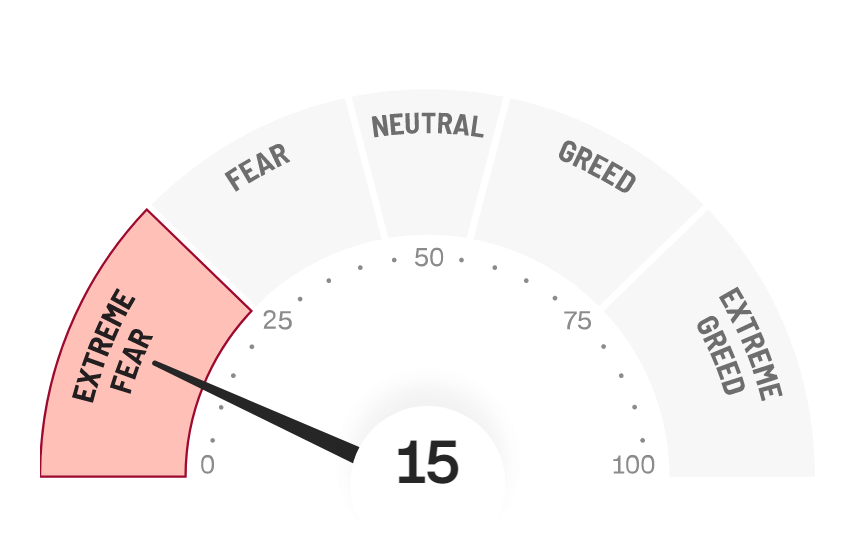
In times like this there are a handful of options, but they eventually circle back to basically two choices or outcomes. Fear often determines which choice will be taken. Fear can be fear of missing out, or fear of more pain. Right now, it’s fear of more pain, CNN has a gauge of investor sentiment, and it currently looks like this:

While market corrections and bear markets always get reversed, no one truly believes it when things are dark. The turnaround usually starts unexpectedly. At the point we’ve been thinking things can only get worse.

The liquid and diversified portfolio is not alone in having a torrid moment. Everything comes with its own risks, and many have reared their heads.

Real estate? We’ve turned homes into financial assets and now they’re performing like them. More volatile, but unfortunately, at higher prices, which makes the volatility more painful when any falls come. According to CoreLogic, since the RBA surprised everyone with a rate rise in May, the 5 city aggregate of Australian house prices has fallen 5.6%, with Sydney down 9%.

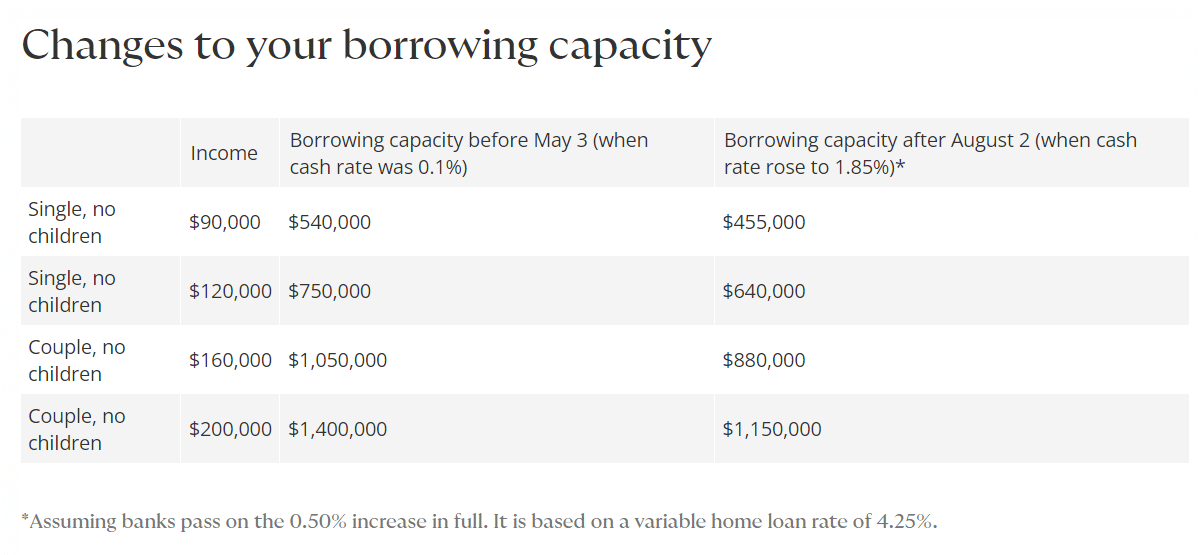
Why? A person or couple’s borrowing capacity remains a major influence on real estate prices. This example from Zenith Finance (assuming a 20% deposit) highlights how things changed from May to the August rate rise. Borrowing capacity would have deteriorated further with the September rate increase, along with any other increases to come. Current buyers don’t have the same ability to pay what buyers did when the cash rate was at 0.1%. If rates turn down again with an economic slowdown, it will alleviate some of the pressure, but those wild real estate gains in the year prior to May 2022 can mostly be attributed to the 0.1% cash rate.

What about the short stays?

People are on the streets. Investors are renting out residential properties like they’re a hotel. Governments are using purpose built tourism accommodation to house the homeless. Cockeyed doesn’t even begin describing it. Government talking about using tax dollars to build more social housing while Airbnb cannibalises the rental market is strange.

Councils are beginning to recognise the problem. Hobart City Council are tightening the screws on Airbnbs. Another council in Tasmania has already jacked up waste levies for short stays. One investor, who’d convinced himself that buying three properties in the same town and turning them into Airbnbs was shrewd, was not happy his lack of diversification caught him out. It may only be the beginning.

Precious metals? Generally, when markets sell off, we field some questions about gold. Those questions have been non-existent. Which says something, in rough times investors turn their attention to what’s going up. Gold isn’t. Despite being the widely acknowledged crisis “safe haven”, this time even gold has come up short. Off 15% over the past six months. Silver’s another one where there’s always hype in some corners of the internet that a boom isn’t far away. Apparently, the silver price is being perpetually “manipulated” by investment banks. Apart from an occasional spike here and there, the silver price hasn’t done much recently or long term.

Bitcoin, another one that was forecast to be a safe haven and a form of “digital gold”. It’s been in the doghouse since the US Federal Reserve started raising rates, down almost 60% and behaving more like a volatile tech stock than a safe haven. Bitcoin’s still higher than it was pre-pandemic, but it’s been behaving closer to a tech stock. Maybe in another fifty years when there’s more data, we’ll know exactly what bitcoin should be used for.

Cash, it went away for a while, but as rates creep up it’s looking seductive again. That’s if we ignore tax and the reason why rates are increasing: inflation, which means there’s still a negative real return like everything else that’s below the inflation rate. And there’s talk that if central bankers hike rates high enough, then recession follows, and rates are cut again to ease the pain. That’s great for all the risk assets investors jumped out of and not great for the cash they jumped into.

Back to financial markets, what do they do from here? We don’t know. Despite the fact we always discourage it and say it’s not possible, we have seen people successfully time markets. Of course, it only happens once because it’s luck, and luck plays with our minds because we think it’s skill. It feels great to see markets take a tumble after selling. Confirmation we were right! Might even get to talk about how prescient the decision was, but the clock’s ticking. To make a market timing exercise work we’ve got to be right twice. Imagine selling out in the days before Covid smashed the markets in 2020, only to sit out until markets recovered all their losses and then went higher. It’s how skill is exposed as luck.

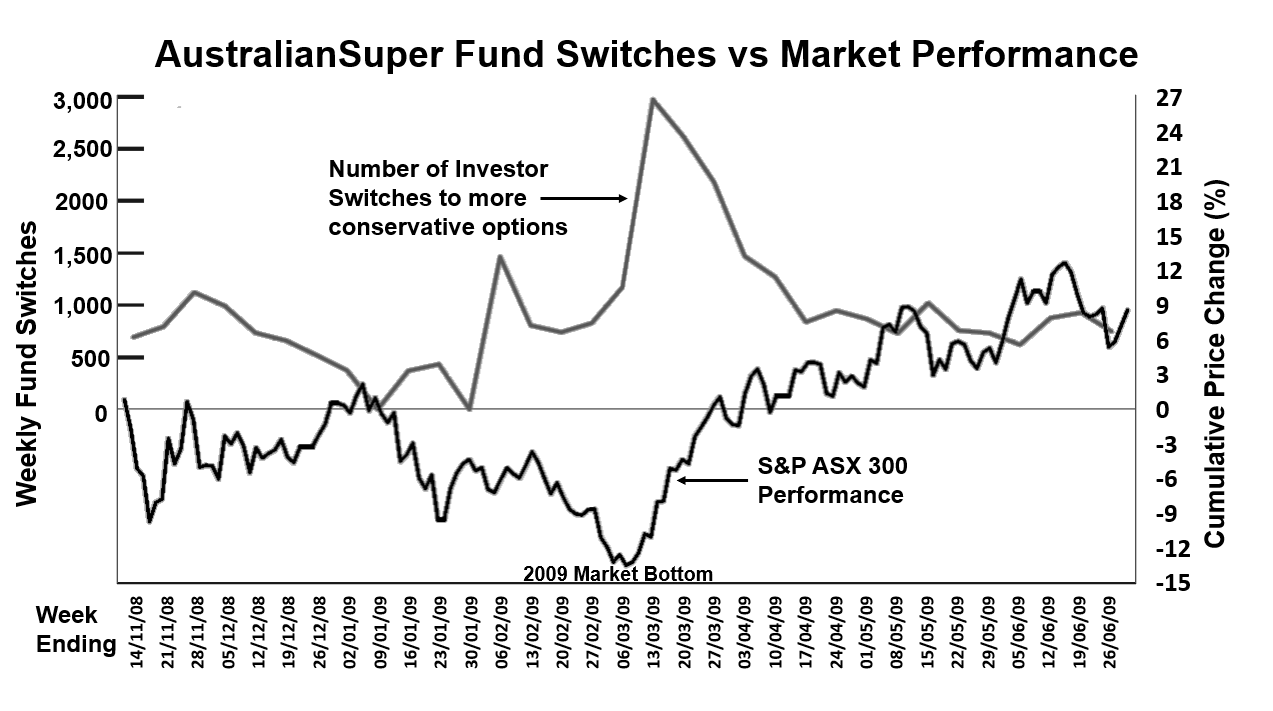
This chart from 2009 highlights how we often get market timing wrong. As the market bottomed in March 2009, the number of AustralianSuper members switching to more conservative portfolio options spiked. They missed the recovery.

With most everything in the doldrums, the question is what now?

The two ultimate choices are act or don’t act. Act means trying to will something into changing.  Act means picking something different and hoping it may avoid further pain or recoup market losses, while hoping the market doesn’t turn and make the decision futile. Don’t act means sticking with our plan. Knowing that we don’t get 6, 7 or 8 per cent consistently every year. It’s something that’s targeted over a decade.

As we always say, returns are lumpy. They don’t come in a straight line and they’re not smooth because they’re often based on sentiment and expectations. Bad days or better days. Sentiment can change very quickly.

This represents general information only. Before making any financial or investment decisions, we recommend you consult a financial planner to take into account your personal investment objectives, financial situation and individual needs.

Filed Under: Uncategorized

July 11, 2022 by John Duncan

2022 Q2 June Quarter Review

Economic Overview

The major theme from Q2 was the swift upward movement of interest rates to combat inflation, along with the implications for economies, sharemarkets and bond markets. Two of the three Central Banks that may have been considered laggards up to this point, the US Federal Reserve and Australia’s Reserve Bank, appeared to be making up for lost time in Q2. Both moved aggressively, with sharp increases in rates during the quarter. Energy also came into focus, as the war in Ukraine continued and the thinking turned to potential gas shortages in Europe. Any remaining euphoria from 2021 left financial markets in Q2, with the quarter being poor for both sharemarkets and bond markets. The cost of living was noted to be a major issue across most economies.

In the US, the focus narrowed in on inflation and the likely response from the Federal Reserve after a 0.25% increase in March. Annual US inflation, as measured by the consumer price index (CPI), came in at 8.6% in May, the largest increase since the period ending December 1981. The food index increased 10.1% annually, which was the first double digit increase since March 1981. Expectations were for 0.5% rate increases in May and June, but with inflation becoming a bigger issue, the Federal Reserve increased rates by 0.5% in May and 0.75% in June, bringing the federal funds rate to 1.58%.

The Federal Reserve signalled more rate rises were to come, but also admitted it has a challenge to bring inflation down and not cause a recession. The US economy still appears robust, with the job market continuing to be tight. Unemployment is at 3.6% with an estimated 1.9 job vacancies for every person looking for work, but there are signs of a slowdown. Flash US Manufacturing Purchasing Managers Index (PMI) fell from 57 in May to 52.4 in June, indicating the slowest growth in factory activity in two years.

Source: RBA 2022

In the Eurozone, ongoing disruption to German gas supplies due to the war in Ukraine saw Germany move to phase two of its energy emergency plan. Phase three would involve rationing gas to industrial users, and possibly households. The war has seen the largest displacement of European citizens since World War 2. Prior to the war, the EU faced headwinds due to supply-chain disruptions, and goods inflation. The war triggered sharp increases in energy and commodity prices, especially those heavily linked to Russian trade. Positively, job growth continued on its post-pandemic stable trajectory.

A Eurostat inflation estimate for June stood at 8.6% in Europe, up from 8.1% in May, with energy being the largest factor in the rise. In its June policy decision release, the ECB noted it would increase rates 0.25% in July, with another move expected in September. Concerns over the cost of living and possibility of recession saw the European consumer confidence reading fall to -23.6 in June, the lowest level since the early stages of the pandemic. Given the ongoing war and the fact its key rate was already negative, the ECB has a big challenge ahead with potential stagflation, where economic growth stalls as inflation increases.

In the UK, The Bank of England made two consecutive 0.25% hikes to take the Bank Rate to 1.25%, as it continued to warn of higher inflation. April’s CPI came in at 9% with May’s at 9.1%, driven by a significant increase in energy prices. This was the highest annual figure since the current set of UK National stats began in January 1997, with modelling suggesting it was likely the highest figure since 1982. The Bank of England forecasts peak inflation to be 10%, before falling back to 6% by the end of 2022. UK GDP is estimated to have grown by 0.8% in Q1. UK chancellor Rishi Sunak unveiled further measures to help households offset higher energy bills.

In Japan, the yen weakened significantly against the US dollar, breaching the 130 level for the first time in two decades. Comments from the US Federal Reserve pointed to a widening interest rate differential with Japan materialising earlier than expected. Despite some pressure to address interest rates, the Bank of Japan didn’t move, and policy remained unchanged. With the rising cost of living a global issue, in Japan the public have thus far remained relatively unscathed. Inflation numbers released in May, showed core CPI (excluding fresh food) jumped to 2.1%. Data released toward the end of Q2 showed worldwide production at Japanese automakers declined for a third consecutive month, with poor supply of parts from China an issue.

In China, there were signs of improvement during Q2 after a tough Q1. Strict Covid-19 protocols enacted by the government resulted in lockdowns in several major cities, leading to the closure of multiple manufacturing factories. Shanghai, China’s largest city by gross production, was locked down tightly while Beijing and other parts of the country also imposed varying levels of quarantine to contain the worst outbreak since the pandemic began. Manufacturing PMI for China rose to 49.6 in May from April’s 26-month low of 47.4, amid an easing of COVID-19 restrictions. The government have taken further steps to encourage growth, lowering a key interest rate for long–term loans as well as issuing a statement of intent to provide clarity on regulation in the technology sector.

In Emerging Markets, it was a mixed bag, often depending on commodities produced. Net industrial metal exporters, such as South Africa, Brazil and Peru, struggled due to fears of a lack of demand for materials from Chinese factories, and the copper price spending the majority of the quarter in a downtrend. Net energy exporters, such as Kuwait, Qatar and Saudi Arabia, fared much better. Hungary and Poland struggled due to proximity to Ukraine, with Poland hit hard following Russia’s decision to restrict energy supply. Central banks in both countries increased policy tightening, while the Hungarian government announced windfall taxes on banks and other large private companies.

Back in Australia, data released in June showed GDP increasing by 0.8% for Q1 2022, with year-on-year growth at 3.3%. The savings rate was at 11.4%, still well above pre-covid levels. The biggest event for the quarter was the election, with the Labor party forming a majority government. However, there was little time for a honeymoon as soaring east coast energy prices posed an immediate issue for households and businesses.

The other big news in Q2 was interest rates. After reaffirming in March that “the Board will not increase the cash rate until actual inflation is sustainably within the 2 to 3 per cent target range”, inflation for Q1 came in at 5.1% in data released in late April. A few days later at their May meeting, the RBA increased the cash rate by 0.35%. The board noted “resilience of the Australian economy is particularly evident in the labour market”. The RBA board followed with another 0.5% increase in June. As expected, the property market quickly felt the rate increases. CoreLogic’s 5 Capital City Index saw a -0.9% fall for Q2, with the most expensive markets, Sydney down -2.8%, and Melbourne down -1.8%, the big drags.

Market Overview
Asset Class Returns
The following outlines the returns across the various asset classes to 30 June 2022.

Global sharemarkets continued their poor performance in Q2 as they priced in the reality of rising interest rates. This also saw bond prices continue to face headwinds as rates moved upward (when rates increase bond prices fall, when rates fall bond prices rise). The 10-Year US Treasury yield moved from 2.35%, finishing Q2 at 2.98%, with 2-year yields rising from 2.33% to 2.92%. In the UK, the 10-year yield moved from 1.61% to 2.23%, while the Australian 10-year yield moved from 2.84% to 3.66%. All 10-year yields saw much higher peaks in mid-June, before the market started considering the potential for recessions if Central Banks misstep and the prospect rates may not increase as much as expected. Overall, it was said to be the worst period for bonds since 1842.

US shares were negative in Q2 with investors focused on inflation and the response from the Federal Reserve. Declines hit all sectors, although consumer staples and utilities remained the most resilient. There were dramatic declines for some stocks, most notably in the media & entertainment and auto sectors, Disney was down 31% and General Motors 29%, for the quarter. After 2021 being a stellar year for earnings growth, the estimated earnings growth rate for the S&P 500 in Q2 was 4.1%, that would be the lowest since Q4 2020 at 3.8%.

Eurozone shares struggled as hope for a resolution or ceasefire in Ukraine faded during the quarter, as early talks failed to yield any significant agreement. Top performing sectors included energy and communication services while information technology and real estate experienced sharp falls. Despite a high exposure to financials and energy sectors and a relative lack of technology names, the French and German markets saw losses of -11.32% and -11.29% respectively.

UK shares were again more resilient than most of their global counterparts, although the large cap FTSE 100 saw a 4.5% fall for Q2, but again smaller areas of the market suffered double digit falls. By sector, the positives were healthcare 5.86%, telecommunications 3.08%, energy 1.55% and consumer staples 1.23%. Consumer discretionary sectors, such as retailers and housebuilders, performed particularly poorly. This was in line with many other developed markets seeing high levels of inflation.

Japanese shares were negative over the quarter, with the Nikkei 225 down 5%, with the bulk of companies reporting results in May. With the current macro environment, there were few positive surprises, and some companies kept their forecasts for the coming year quite conservative. However, the tone of results and guidance was still better than expected. Chipmakers Tokyo Electron and Advantest were punished in June, while Kansai Electric was up 16% for the quarter as the mood toward nuclear energy softened due to the ongoing energy crisis.

Asia (ex-Japan) and Emerging markets shares were also sold off in Q2, albeit with emerging markets being one of the better performers in Australian dollar terms, down -3.3%. South Korea struggled, with financials, technology and energy companies badly hit amid fears of a recession. Shares in Taiwan were also significantly lower on fears rising inflation and supply chain problems would weaken demand for technology products. Indian shares also declined over the quarter as global volatility, rising inflation and soaring energy prices weakened investor sentiment. China was the only emerging market to generate a positive return over the quarter.

The Australian market (All Ords Accumulation) was up for April, but sold off heavily in May and June with the RBA’s interest rate announcements, along with global factors weighing. All Ords falls almost mimicked those of the Financials market sector as there were fears a housing slowdown would put pressure on earnings for Australia’s big four banks, though banking figures dismissed this toward the end of the quarter, suggesting they were well provisioned to deal with any issues and Australians were still sitting on significant levels of cash. Other sector weakness was seen in Consumer Discretionary and Information Technology, Materials and Real Estate. Utilities and Energy managed small gains.

Finally, there were eyebrows raised about some of the newer inclusions to the ASX 200. The lithium explorers who’d previously been flying, such as Core Lithium and Lake Resources, found themselves with a market capitalisation large enough to be included in the major benchmark and were promptly sold off heavily on inclusion. Lake fell 55% in the week after inclusion and Core fell 30%. Battery metal companies have been booming and busting for several years now, showing as volatile as markets can be, hot sectors can do a 180 flip at a much faster pace.


Where to From Here?

Whether you want to call the last quarter “repricing”, “selling off” or “losing”, the result is still the same: it’s not nice, but it’s nothing new. Markets have a habit of panicking first and asking questions later. That means returns never come in a straight line and at various points in time we’ll see losses in our portfolio. If you’re measuring by the end of June 2022, you will see losses, the reality is the market has already moved on. In the subsequent days, the ASX is up over 2% and the US markets are up over 3%. Will that last, continue or go into reverse?

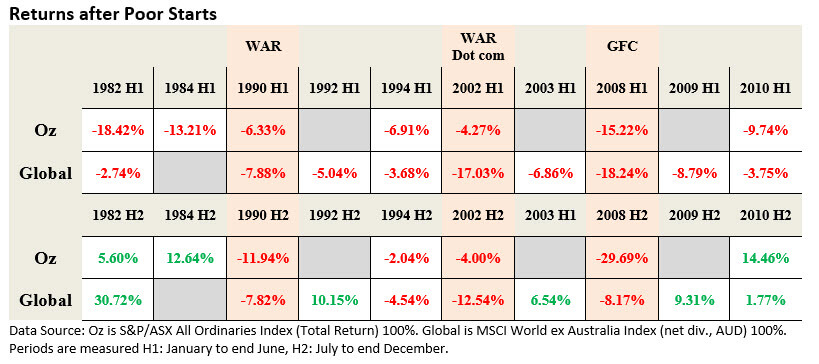
We don’t know, but we’ve taken a look back in time to see what bad starts to the year since 1980 look like and what followed. We’ve looked at both Australian and Global shares. In some instances, while one market fell in the first half of the year (H1), the other didn’t, so it’s greyed out, and we had no need to look at the second half (H2).

It’s not particularly conclusive because it also includes three anomalies where the years where quite torrid for notable reasons. One, being a gulf war. Two, being the aftermath of a terrorist attack, the leadup to another gulf war and the end of the dotcom bubble. And three, a major global financial crisis in 2008. Are we currently in such torrid times? That depends on who you ask, but excluding those markets, there have tended to be bounce backs in the second half of the year after a poor start, 1994 being the outlier.

For US shares (using the S&P 500) we have seen one of the poorest starts to the year since the 1960’s. Since 1960 there have only been two first half losses in the magnitude of 2022’s, those were in 1962 which saw a -22.28% fall and 1970 which saw a 19.43% fall. What followed? In 1962 it was a 17.44% recovery and in 1970 it was a 29.11% recovery.

We don’t know what happens next, but we do know as shares sell off, historically, expected returns are higher. What we do know is shares and bonds are both cheaper than they were and now present an increased opportunity for yield. For long-term investors, there are mixed signals. There is still pent up demand, and a huge demand for labour, but weakening consumer confidence. There is talk of recession, but the economy spends most of the time in expansion, so it’s ultimately better to invest for growth.

Returns never present themselves in a neatly wrapped box. The risk, or price we pay, is the volatility we need to endure to get the return. If we’ve stayed for the risk, we may as well stay for the reward.


This material is provided for information only. No account has been taken of the objectives, financial situation or needs of any particular person or entity. Accordingly, to the extent that this material may constitute general financial product advice, investors should, before acting on the advice, consider the appropriateness of the advice, having regard to the investor’s objectives, financial situation and needs. This is not an offer or recommendation to buy or sell securities or other financial products, nor a solicitation for deposits or other business, whether directly or indirectly.
Filed Under: Uncategorized

March 31, 2022 by John Duncan

Federal Budget 2022/23

The final Federal budget before the imminent Federal election has been released. Given the proximity between these two events, the budget wasn’t expected to be overly frugal and there are goodies. There are one off payments and tax rebates coming to try and keep everyone happy. Some warranted, others debateable.

It’s worth remembering we’ve had strong equity markets, record house price growth, record stimulus and the lowest interest rates the country has seen. There’s $250 billion sitting in household savings accounts and the unemployment rate is projected to fall below 4% (even if the basis of this figure is questionable). The idea that a large number of people in the middle class need a boost from government after such a boom is an interesting one.

Forecasts for net debt have improved, expected to now peak at $864 billion in 2025/26. Last year the forecast was sitting at $980 billion for 2024/25. No doubt the government was keen to avoid the one trillion mark in forecasts, along with the potential headlines that would accompany it. The budget deficit for 2022-23 is $78 billion.

The budget has an optimistic outlook on lower inflation and higher wages growth. Over the next few years wages are expected to grow at their fastest pace in a decade over, from 2.75% to 3.25 per cent next year and 3.5 per cent by 2025. At the same time, despite all the additional spending, the budget suggests inflation will “peak well below that in most other advanced economies”. There’s no mention of what that peak is, but budget forecasts have the consumer price index at 4.25% before subsiding to 3% by June 2023 and 2.75% in 2024 and 2.25% in 2025.

Some continue to be worried about inflation, believing these figures will come under pressure. From veteran business journalist Robert Gottliebsen:

Treasury has told Frydenberg that we can control inflation partly because higher commodity prices are boosting the dollar and wage increases will be moderate. They say that while the increase in the hourly wage rate in the 12 months to June 30 is five per cent it will slump to 3.5 per cent in the next financial year. And that will happen because the CPI index, having risen by 4.25 per cent in 2021-22, will rise by only three per cent in 2022-23.

Those estimates look incredibly low given that the Treasurer is campaigning for higher wage rates and the core of the ALP campaign (and they are way ahead in the opinion polls) is for higher wages.

Onto the relevant points from the budget.

Income Tax/Individuals/Families

Low and Middle Income: The low and middle income tax offset has been retained and increased for the current financial year. Those earning up to $126,000 will see up to a $1500 offset when they file their tax return for this financial year.

However, workers should be aware the low and middle income tax offset has been omitted from the next financial year. If you’re filing your tax in July 2023, there will be no more relief unless it is extended at the next budget.

Employee Share Schemes: Access to employee share schemes has been expanded. Where employers make larger offers in connection unlisted companies, participants can invest up to:

$30,000 per participant per year, accruable for unexercised options for up to 5 years, plus 70 per cent of dividends and cash bonuses; or any amount, if it would allow them to immediately take advantage of a planned sale or listing of the company to sell their purchased interests at a profit.

Digitalising Trust Income Reporting: Trust and beneficiary income reporting and processing will be digitised, allowing all trust tax return filers the option to lodge income tax returns electronically, increasing pre-filling and automating ATO processes.

Paid Parental Leave: Single parents can now access the full 20 weeks of paid parental leave. Couples will get greater flexibility in deciding how paid leave is divided between them. Eligibility criteria will also be broadened. Under the current laws, mothers earning up to $151,350 can access paid leave, but anyone earning more is not entitled to it. The government is broadening the threshold so that any household with an income of up to $350,000 can use of the 20-week scheme.

Superannuation/Retirement

Superannuation Minimum Drawdown Reduction Extension: The 50% reduction of superannuation minimum drawdown requirements for account-based pensions has been extended until 30 June 2023. This has been done to ensure retirees have certainty and don’t have to draw down on assets and potentially sell at a loss. Thankfully this was the only superannuation change or non-change as it were. It’s not a bad one, but it does pose a question: if we’re going to change drawdown rates every time there’s a market upset or scary world event, why not just lower drawdown rates permanently?

Social Security

Cost of Living Payment:  This is a $250 economic support payment to help eligible social security recipients with higher cost of living pressures. The payment will be made in April 2022 to eligible social security recipients such as pensioners, carers, veterans, job seekers, eligible self-funded retirees and concession card holders.

Pharmaceutical Benefits Scheme Lower Safety Net Threshold: From 1 July 2022, the Government is reducing the PBS Safety Net threshold, from $1,542.10 to $1,457.10 for general patients and from $326.40 to $244.80 for concessional patients.

Housing

Home Guarantee Scheme Increased

The Government will increase the number of guarantees under the Home Guarantee Scheme to 50,000 per year for 3 years from 2022-23 and then 35,000 a year ongoing for homebuyers to purchase a home with a lower deposit.

35,000 guarantees per year ongoing for the First Home Guarantee (formerly the First Home Loan Deposit Scheme) 5,000 places per year to 30 June 2025 for the Family Home Guarantee. 10,000 places per year to 30 June 2025 for a new Regional Home Guarantee that will support those who have not owned a home for 5 years to purchase a new home in a regional location with a minimum 5% deposit.

The merits of the government backing 2-5% deposits as house prices are at record highs, interest rates are at record lows, and inflation is increasing, are very questionable, but politicians are addicted to buy side housing “affordability” measures, and we note the opposition is proposing something similar.

Business & Training

Apprentices: A $2.8 billion investment to increase take up and completion rates of trade apprenticeships.  New apprentices will access to a $5000 payment, while employers who take them on will be entitles to wage subsidies up to $15,000. $38 million over four years to support women starting trades on the national apprenticeship priority list.

National skills agreement: $3.7 billion for an additional 800,000 training places to help find employment for disadvantaged youth, Indigenous Australians, the mature aged and Australians with a disability.

Small Business Training: For every hundred dollars a small business spends on training their employees, they will receive a $120 tax deduction. Capped at $100,000.

Small Businesses Technology Investment Boost: For every $100 small businesses spend on digital technologies such as cloud computing, eInvoicing, cyber security and web design, they will get a $120 tax deduction. Capped at $100,000.

Additional Cost of Living Relief

Temporary Reduction in Fuel Excise: With fuel prices moving over $2 a litre, the government has reduced the fuel excise by half from March 30 for six months. The rate of excise applying to petrol and diesel is 44.2 cents per litre, which will cut it to 22.1 cents per litre. GST is also levied on excise, so consumers may see a little bit more than a 22.1 cent reduction.

As always, to ensure to you make the most of your money, your adviser can offer advice on how to best apply it to your circumstances.

This represents general information only. Before making any financial or investment decisions, we recommend you consult a financial planner to take into account your personal investment objectives, financial situation and individual needs.

Filed Under: Uncategorized

February 8, 2022 by John Duncan

The Historic Market Crash

“It has been a really tough weekend,” said Harold Camping as he answered his door to reporters on a Sunday afternoon back in May 2011.

Given the circumstances, it could have been a lot tougher. The 89-year-old Christian fundamentalist radio preacher had been telling anyone who would listen that the rapture would occur a day earlier at 6pm Saturday. Massive earthquakes would strike, believers would ascend to heaven while everyone else would be left to wander a godforsaken hellhole. After enduring five months of torment, the detritus left behind would see the world explode into a fireball by late October.

It didn’t take long for Camping to straighten his spine and revise his call. After finding some errors in his calculations, Camping suggested the May call was premature and October 2011 was “probably” the right forecast for both the rapture and the end of the world. Thankfully, Harold missed on that call also.

Camping started his forecasts in the late 1980’s. Back then, 1994 was the initial target for his prophecy of doom. When 1994 didn’t come to pass, he was forced to admit he’d found some calculation problems which explained the miss. After forgetting about the idea for a while, in 2005 Camping came up with the 2011 target for the end of days. The genius of such a long lead left plenty of time to sell some books and build a following for the apocalypse. Camping had a radio show where he spruiked to the gullible and garnered some media attention.

You might wonder why the media would give any space to Camping, but they did. He spent up a storm trying to promote his forecast. Many of his acolytes followed his lead by buying billboard advertising and handing out pamphlets around the world. It was this strange circus of doom that likely caught the media’s attention as an oddity.

Thankfully, the media didn’t give Camping the most balanced coverage. Any perceptive reader could sense there was an undercurrent of ridicule in most stories and there was always a prominent reminder of his previous failed predictions. When Camping passed away in December 2013 the failed predictions featured prominently in his obituaries, and with good reason, as illustrated by New Jersey pastor J.A. Jones’ conversation with The Philadelphia Inquirer in 2011.

Many of his parishioners have heard Camping’s warnings, Jones said, and asked him anxiously if the May 21 date is true. “I tell them, ‘No, but if you’re so concerned, why don’t you deed us your house and car?’ and then they laugh. … Everyone who ever made those predictions got egg on their faces,” Jones said.

Some others, without access to such a sober second opinion, took Camping seriously and were left dealing with the consequences. Mostly it was frustration and some wounded pride among his spooked acolytes. Eighty of Camping’s South African believers booked out a hotel for an end of the world shindig, all with the expectation they wouldn’t be around to pay the bill! Not so funny were some tragic outcomes. A suicide, an accidental drowning, and attempted murders were all prompted by panic among believers of Camping’s forecast.

While Harold Camping was well removed from the investment space, he’s someone we never fail to think of at least a couple of times a year because of forecasts like this:

Billionaire investor says historic sharemarket crash is ‘nearly certain’

Jeremy Grantham of asset manager GMO published his historic crash forecast just as markets were swooning in January. It quickly caught the attention of many in the media, who had little problem acting as “his master’s voice”.

Is Jeremy Grantham a dangerous kook like Harold Camping? No. Grantham is interesting, he has views that are worth considering, he has 50 years of experience behind him, and he has been right in the past. He’s also been catastrophic and alarming on a regular basis over the past decade, without success. Anytime you hear someone predicting a crash, put their name into google and include a year, in this instance maybe 2010, and see what shows up.

Then try 2011.

Anyone who cares to look can see this has been going on for a while. The galling thing is it’s not noted when the mainstream media report on Grantham’s forecasts. Previous misses are excluded, and the new forecast is put up in lights to spook investors without any of the baggage that this has been occurring almost annually. However, we don’t see this as a Jeremy Grantham issue. He’s very much entitled to his views. Grantham has been writing on GMO’s website on a regular basis over an extended period. It’s only when he has a disaster forecast that the media chooses to pay it attention, and then amplify it further.

This is not uncommon. Crash forecasts are treated with the utmost seriousness by the media and the forecaster’s track record is selectively referenced by highlighting the wins and excluding the many misses to make the story seem more prescient. In contrast, if you’re predicting the end of the world there’s immediate skepticism, an undercurrent of ridicule and prominent reminders of prior forecasts that didn’t pan out, as the Harold Camping example shows.

The issue with news about “nearly certain” crashes and selective reporting of track records is investors panic when hearing this stuff. We’ve had questions about it. All we can do is play the role of Pastor Jones. Offer a sober second opinion and some perspective beyond the one offered up. Most crash forecasts miss because the market rarely crashes. No one can time markets with any real and consistent success. Every decision prompts another decision, which sooner or later results in a costly mistake. We’ve always found doing nothing is the best course of action. Our most successful clients are the ones who’ve sat dispassionately in their seats for decades.

What’s notable about this story is what we didn’t hear and what we weren’t asked about. No one mentioned tech companies such as Microsoft, Apple, and Google are currently smashing earning expectations, so this conflicts with the idea of a massive market decline when these companies help drive the market. No one asked: “should we buy emerging markets, resources, and value stocks?” Because that’s also where Grantham said was the best place to be positioned, he didn’t say sell everything and sit in cash, but that’s not a great headline. In contrast “historic sharemarket crash” gets a chest tightening reaction.

We understand the oversight and the fear, but we run diversified portfolios spanning asset classes and sub asset classes. A core component of those portfolios is exposure to those big winners in the US and value stocks both in Australia and globally. There is also a small exposure to emerging markets. The portfolios are constructed on an all-weather basis because returns are never consistent. Today’s winner can be tomorrow’s loser and vice versa.

March 2020 seems like a long time ago. The Covid panic was quickly swept away by fiscal and monetary largesse. It wasn’t normal and has to end. As the animation shows, sharemarkets see a double-digit dip almost every year. Last year markets moved upward with hardly an incident. That is an exception, not the rule. Market volatility is normal, last year wasn’t normal and many investors quickly grew accustomed to that investment Disneyland. Recent weeks offered a reality check. We can’t put too fine a point on it, but we all need to get used to volatility again.

Your decisions are relative to your goals.

If you’re in your 40’s and your retirement is two decades away, just keep doing what you’re doing. There will be plenty more volatility and plenty of corrections ahead in the next twenty years. To get where you’re going, you’ll have to put up with them.

If you’re retired, in general, your portfolio is likely constructed and managed in a way to ensure short term spending is covered with cash and short-term fixed interest. Profits should harvested after a good run because that’s tomorrow’s spending.

Aside from the incendiary media coverage, experienced investors are worth listening to, in their totality, but never be overawed by the terms “billionaire” or “legend”.  Keep perspective, no matter how persuasive someone seems, history will show they don’t always get it right. Someone may be able speak at length and seem convincing because they’ve seen everything.

But just like Harold Camping, there’s still one thing they haven’t seen: the future.

This represents general information only. Before making any financial or investment decisions, we recommend you consult a financial planner to take into account your personal investment objectives, financial situation and individual needs.

Filed Under: Uncategorized

December 17, 2021 by John Duncan

How Much Do I Need To Retire?

It’s one of the most vexing finance questions there is. While it seems like a straightforward one, it’s really a question that only invites further questions. Not about the money, but about the person or persons who are retiring. There will never be a one-size-fits-all pot of money. Primarily because of how many different variables come into play.

What do you want to spend?

Will your spending change?

What your returns will be?

What is the sequence of those returns and how volatile will your portfolio be?

The first two questions are the most controllable. Everyone will have fixed costs based primarily on their shelter, transport, food, clothing and possibly healthcare. These can be elastic to a point. There may also be bigger ticket items that need addressing along the way. It’s a heroic assumption to assume a 30-year retirement will chug along without a repair to a house or an appliance replacement. There are other living related costs we may have the ability to tweak such as entertainment and holidays, depending on lifestyle demands.

The second two questions aren’t controllable and they’re not even knowable. The best anyone can do is assess the range of historical outcomes from various portfolios and make a choice based on the risk they are willing to bear to achieve their spending goals.

This is where the dollar figure comes in, but it needs to be paired with a sensible withdrawal rate. If you’ve got $1,000,000 and you want to spend $100,000 a year for 30 years, you can certainly try, but you’ll need a lot of good market fortune early in the piece for the portfolio to compound and outpace the withdrawals. A 10% withdrawal rate is doable, but it’s not advisable.

For example, if you tried this using a million-dollar portfolio with 80% in growth assets starting in January 1991, today you’re left with $622,000, after withdrawing $4.4 million along the journey. Proving it can be done, but if you tried this starting exactly 12 months earlier your portfolio would be exhausted in 2008.

There are inevitable questions here. The big one is the aggressiveness of the portfolio. It’s a brave retiree who charges into retirement holding 80% of their portfolio in shares and real estate. It’s an even braver one who draws 10% of the portfolio annually adjusted for inflation, so there’s really no choice about increasing risk. It must be done. A 10% withdrawal rate must aim for something higher than a 10% annual return, and that’s not feasible by being heavy in cash and bonds. Start with a less aggressive portfolio in 1991 and it’s exhausted earlier than 30 years.

Even so, these are very optimistic scenarios. Getting 19 years or even 30+ years starting with a 10% withdrawal rate should be considered best case outcomes. Using a very unwelcome event offers the most sober assessment. Try this in 2008 with the financial crisis and you would have been lucky to get ten years out of any portfolio while withdrawing 10%.

Going back to the original questions, it’s the “what do you want to spend” that’s more in a retiree’s control, so how does a 5% withdrawal rate look?

Much better. Starting from one of the worst possible times, no matter whether a portfolio was an aggressive 80% in growth assets, a middle of the road 60%, or a more conservative 40%, by well into 2021 all were above their initial starting position. And the most important thing, all had provided more than $800k in retirement spending.

The outcomes above are also factored on monthly withdrawals. Run them again annually, or biannually, and they present different results again. The long-time rule of thumb is a 4% withdrawal rate should ensure certainty of inflation adjusted spending from a 60/40 portfolio over 30 years. Recently this has been brought into question. Low returns from bonds and lower expectations going forward from shares, after some strong returns in recent years, have prompted suggestions 3.3% is the new safe withdrawal rate.

Which is it?

A 10% withdrawal rate will be more luck than common sense. A 5% withdrawal with a bad start followed by a decent tailwind can get you 15 years with your principle intact, whether it makes it another 15 years is unknown. A 4% withdrawal will look even better to weather rougher seas. What about a 3.3% withdrawal rate?

Wouldn’t a 2.3% withdrawal rate look even better? It would, but at some point, you need to settle on a feasible amount to live and enjoy life! No matter what is chosen, a retiree is always heading into the unknown. The focus shouldn’t be 4% or 3.3% because life doesn’t exist on a spreadsheet. It should be what leads to getting the most out of life. The scenarios used earlier have multiple different inputs, but they’re also static in their withdrawals. Inflation is factored, but real-life investor decisions aren’t.

Goals change. Spending may change. A portfolio may fall below the level that triggers social security eligibility. Inflation will change. Human emotion may trigger a panicked decision. A retiree may get bored and take on a part time job. A portfolio may look like a number on a screen, but it’s subject to so many variables that it may as well be a living and breathing entity. Getting the most out of will be an ongoing conversation an investor needs to have with their adviser.

So how much do you need to retire?

It depends.

This represents general information only. Before making any financial or investment decisions, we recommend you consult a financial planner to take into account your personal investment objectives, financial situation and individual needs.

Data Source: 80/20: Bloomberg AusBond Bank Bill Index 2.00%, Bloomberg Global Aggregate Bond Index (hedged to AUD) 13.00%, Dimensional Australia Global Core Equity Index (AUD) 16.7500%, Dimensional Australia Global Core Equity Index (hedged to AUD) 16.7500%, Dimensional Emerging Markets Index (AUD) 3.00%, Dimensional Global Real Estate Securities Composite Strategy 7.00%, FTSE World Government Bond Index 1-5 Years (hedged to AUD) 5.00%, Dimensional Australia Core Equity Index 36.500%. 60/40: Bloomberg AusBond Bank Bill Index 2.00%, Bloomberg AusBond Composite 0+ Yr Index 8.00%, Bloomberg Global Aggregate Bond Index (hedged to AUD) 10.0%, Dimensional Australia Global Core Equity Index (AUD) 12.500%, Dimensional Australia Global Core Equity Index (hedged to AUD) 12.500%, Dimensional Global Real Estate Securities Composite Strategy 10.0%, FTSE World Government Bond Index 1-5 Years (hedged to AUD) 20.0%, Dimensional Australia Core Equity Index 25.00%. 40/60: Bloomberg AusBond Bank Bill Index 3.00%, Bloomberg AusBond Composite 0+ Yr Index 17.00%, Bloomberg Global Aggregate Bond Index (hedged to AUD) 10.0%, Dimensional Australia Global Core Equity Index (AUD) 8.500%, Dimensional Australia Global Core Equity Index (hedged to AUD) 8.500%, Dimensional Global Real Estate Securities Composite Strategy 6.00%, FTSE World Government Bond Index 1-5 Years (hedged to AUD) 30.0%, Dimensional Australia Core Equity Index 17.00%. Constructed under AUD. Rebalance: Per 12 Months. Inflation is calculated by Australian Consumer Price Index: Returns are restated after CPI for the quarter is released. Interpolated Quarterly data into Monthly data. Scenarios are calculated by drawing income monthly and drawings are adjusted annually for inflation.

Filed Under: Uncategorized

  • 1
  • 2
  • 3
  • …
  • 9
  • Next Page »

Keep up to Date

Powered by VMA-Emailer

Meet John Duncan

John Duncan - Financial Planner

Director for True Financial - John Duncan - Fee Only financial planner To receive the best financial planning advice you need the best financial planner. John Duncan is certainly in that category. John is a financial planner who is unique in not only his high level of knowledge and experience in financial planning but also in the amount of areas that John advises in. A Financial Planner with a strong Education background John is a Certified … Read More

Post Categories

  • Budget (5)
  • General (27)
  • Insurance (2)
  • Investment (14)
  • Property (5)
  • Superannuation (4)
  • Tax Tips (7)
  • Uncategorized (50)

Like us on Facebook

Recent Posts

  • 2025 Q2 June Quarter Review
  • Don’t Vote with your Portfolio
  • Investing Has Been Solved
  • John Hussman: Man Who Predicted…
  • Bank Runs

Privacy Statement

See our Privacy Statement here

Keep up to Date

Powered by VMA-Emailer

True Financial is an Authorised Representative No. 428771 and Credit Representative No. 428873 of FYG Planners Pty Ltd, AFSL/ACL No. 224543. ABN 29 009 541 253

Contact Information: Address: 23 Errard St Kelvin Grove 4059 - Phone: (07) 3169 2570 - Email: admin@truefinancial.com.au - Web Design & SEO by: Visual Marketing

Information provided on this website is general in nature and does not constitute financial advice. True Financial Pty Ltd will endeavour to update the website as needed. However, information can change without notice and True Financial Pty Ltd does not guarantee the accuracy of information on the website, including information provided by third parties, at any particular time. Every effort has been made to ensure that the information provided is accurate. Individuals must not rely on this information to make a financial or investment decision. Before making any decision, we recommend you consult a financial planner to take into account your particular investment objectives, financial situation and individual needs.True Financial Pty Ltd does not give any warranty as to the accuracy, reliability or completeness of information which is contained in this website. Except insofar as any liability under statute cannot be excluded, True Financial Pty Ltd, its employees do not accept any liability for any error or omission on this web site or for any resulting loss or damage suffered by the recipient or any other person. Unless otherwise specified, copyright of information provided on this website is owned by True Financial Pty Ltd. You may not alter or modify this information in any way, including the removal of this copyright notice.
Manage Cookie Consent
To provide the best experiences, we use technologies like cookies to store and/or access device information. Consenting to these technologies will allow us to process data such as browsing behavior or unique IDs on this site. Not consenting or withdrawing consent, may adversely affect certain features and functions.
Functional Always active
The technical storage or access is strictly necessary for the legitimate purpose of enabling the use of a specific service explicitly requested by the subscriber or user, or for the sole purpose of carrying out the transmission of a communication over an electronic communications network.
Preferences
The technical storage or access is necessary for the legitimate purpose of storing preferences that are not requested by the subscriber or user.
Statistics
The technical storage or access that is used exclusively for statistical purposes. The technical storage or access that is used exclusively for anonymous statistical purposes. Without a subpoena, voluntary compliance on the part of your Internet Service Provider, or additional records from a third party, information stored or retrieved for this purpose alone cannot usually be used to identify you.
Marketing
The technical storage or access is required to create user profiles to send advertising, or to track the user on a website or across several websites for similar marketing purposes.
Manage options Manage services Manage {vendor_count} vendors Read more about these purposes
View preferences
{title} {title} {title}