True Financial

  • Home
  • My Prosperity Login
  • About
    • John Duncan – Fee Only financial planner
    • Fee for Service Financial Planning
    • Our Ideal Client
  • Advice
    • Benefits of Financial Planning
    • Cash Flow Management
    • Superannuation
      • What is Superannuation
      • What is a SMSF
      • Contributions Limits
    • Investments
      • Investment Philosophy
    • Insurance Advice
      • Insure The Stay-at-Home Parent
      • Income Protection Insurance
    • Retirement Planning
    • Estate Planning Advice
    • Business Advice
  • Articles
  • Video Library
  • Testimonials
You are here: Home / Articles

October 22, 2021 by John Duncan

2021 Q3 September Quarter Review

Economic Overview

Labour and supply shortages, shipping bottlenecks, COVID delta variant, inflation, vaccine hesitancy. There were plenty of worries in Q3, but markets remained mostly positive across the quarter as economies continued to open and society resumed some normality. This led to an increase in demand in many areas and a struggle to supply that demand. Something governments, businesses and central banks will be dealing with in the year ahead.

In the US, the Fed Reserve stated tapering of quantitative easing will be announced at the November meeting and will finish by mid-2022. Interest rate expectations also moved higher. The 2023 interest rate expectation moved from two increases to three, with another three increases expected in 2024. While 2021 real GDP growth was revised down to 5.9% from 7% growth previously estimated, GDP projections for 2022 and 2023 were increased. Notably, inflation has risen with the Fed now seeing inflation running at 4.2% across 2021, above its previous estimate of 3.4%. Inflation did slow in July and August at 5.35% and 5.25% on the year, but edged up in September to 5.39% annually. These figures are around 13-year highs.

COVID continues to hamper the supply chain, the third largest container port in China was shut for several weeks in August due to one positive COVID case. The backlog stretched across the Pacific to the Los Angeles and Long Beach ports, which together handle about a third of all containers arriving in the US. Such disruptions reverberate along the supply chain, then in the US there was an added problem of a shortage of long-haul truck drivers.
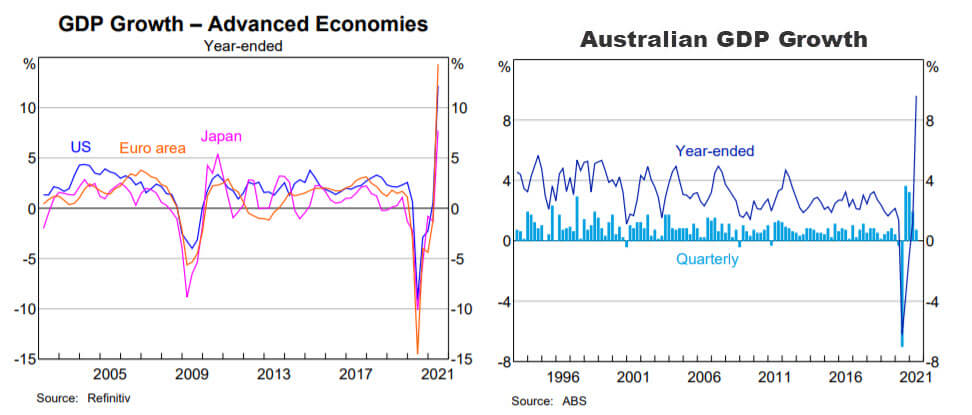
Source: RBA 2021

The shortage of labour became a bigger issue in Q3. There has been confusion as to why US businesses are having trouble hiring and hanging onto workers. In something that has been termed “the great resignation” there could be several factors. The desire for flexibility is one reason. According to the job site Glassdoor, searches for remote work are up 460% in the two years through June 2021. Clearly jobs in restaurants, hotels, and retail can’t be done remotely, but recent articles in publications such as the Wall Street Journal, The New York Times and The Atlantic highlighted changing attitudes to work. Many workers used the pause the pandemic offered, via stimulus payments and free time, to either retrain or look for different work. Some service industry employees returned after lockdown to find the American consumer increasingly rude and verbally abusive, so they tossed in their job. Others simply retired.  As the Fed recently highlighted, there is a financial cushion. The net worth of U.S.households was $142 trillion in Q2 2021, up from $110 trillion pre COVID. Beyond investments, there was $17 trillion in cash and cash equivalents on household balance sheets as of June 2021.

In the Eurozone, the Delta variant of COVID continued to spread, but vaccinations rates in the larger eurozone countries now sits around 75% which has seen restrictions on travel and other activities lifted. As the quarter progressed, inflation, due to supply chain issues became a concern. Eurozone annual inflation was estimated at 3.4% in September, up from 3.0% in August. The European Central Bank suggested “inflation is currently being pushed up largely by temporary factors that are expected to fade in the coming years”, announcing a reduction in the pace of asset purchasing, noting it would tolerate a moderate and transitory overshoot of the 2.0% inflation target. The end of the quarter saw a surge in power prices due to low gas supply and weather-related issues over the summer. Germany held a general election, with the Social Democrats (SPD) receiving largest share of the votes. Coalition talks are under way to form a new government.

In the UK, inflation hit 3.2% annually in August, up from 2% in July and the Bank of England took a hawkish tone, voicing concerns publicly that inflationary pressures were surpassing expectations and likely to peak above 4% and remain high until 2022. At the same time, it reiterated its position that it won’t take action for the time being. Like the US and EU, supply bottlenecks constrained output, while natural gas and fuel shortages cropped up towards the quarter’s end. The vaccination programme continued to reduce the number of virus-related hospitalisations despite the emergence of the delta variant. As a result, the UK government moved to the final easing of lockdown restrictions in July.  Payroll figures moved above pre-pandemic levels and furloughed workers continued to decline across the UK. GDP figures showed the UK economy grew by 4.8% in Q2.

In Japan, politics dominated as Prime Minister Suga stepped down as leader of the Liberal Democratic Party (LDP). Fumio Kishida took over as party leader and Japanese PM. He will lead the LDP into November’s general election. While Suga faced widespread criticism over his handling of the pandemic and his popularity was fading, the announcement was still a shock given he’d only spent 12 months in the role. PM Kishida has flagged additional fiscal stimulus to support the economy through the pandemic.

China’s woes began to unnerve investors in the quarter as the government looked to assert more control in the technology and property space. In technology, China has dished out large fines for monopolistic practices, Alibaba was hit with a record $3.8 billion AUD fine. In property, authorities are looking to rein in debt and bring prices under control, with Evergrande Group struggling to clear $300 billion of debt potentially being a casualty. Evergrande sparked global investor concerns as a default for the group would not only be disastrous for China’s real estate sector (28% of GDP) but would have a significant domino effect throughout the economy, and potentially globally. China is also facing a power shortage, impacting factories and homes, while also trimming economic growth forecasts.

Emerging market countries saw winners and losers due to power and supply chain issues; this was particularly notable across Asia. In South America, Brazil saw several months of interest rate increases to tackle excessive inflation, flagging another to come in October, while metal prices capped growth for other South American nations such as Chile and Peru. Those with significant energy resources such as Russia and several Middle Eastern economies did well. India continued to make progress against the spread of COVID and by the end of the quarter had administered nearly one billion doses, second only to China.

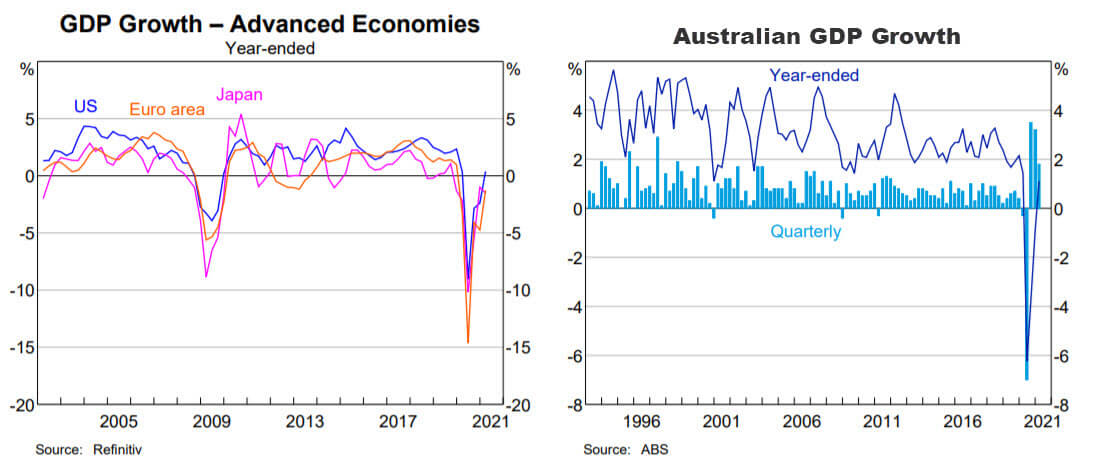
Back in Australia, data released in September showed the economy grew 0.7% for Q2, with year-on-year growth 9.6%, but showed growth slowing from Q1 before the COVID outbreaks in NSW and Victoria. The continued presence of COVID in the two largest states led to more vaccination urgency. By the end of the quarter, 77.8% of Australians over 16 had been administered their first dose and 54.2% of Australians over 16 were fully vaccinated.

Towards the end of the quarter there were media rumblings there would be an intervention in the mortgage market by the Australian Prudential Regulation Authority. There were suggestions of a limit on borrowing, as various housing markets had increased over 25% annually, fuelled by low interest rates. This followed the OECD and International Monetary Fund both calling on Australian regulators to step in to cool the Sydney and Melbourne property markets.

In its September minutes the RBA again said it “will not increase the cash rate until actual inflation is sustainably within the 2 to 3 per cent target range”. Inflation increased to 3.8% in Q2 2021 with the largest increases coming in fuel, pricing for furniture due to timber prices and supply shortages and childcare as free childcare was ended.

Global economic growth is expected to be 6% for 2021 and 4.9% for 2022, according to the International Monetary Fund. If realized, this would be the fastest growth in several generations as 1973 was the last time growth was 6% or higher.


Market Overview

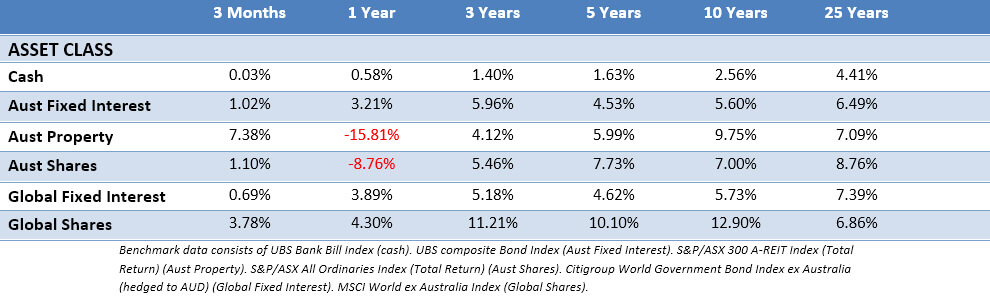
Asset Class Returns

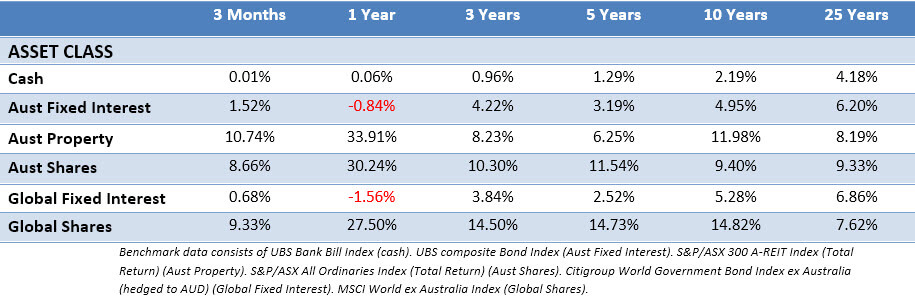
The following outlines the returns across the various asset classes to 30th September 2021.
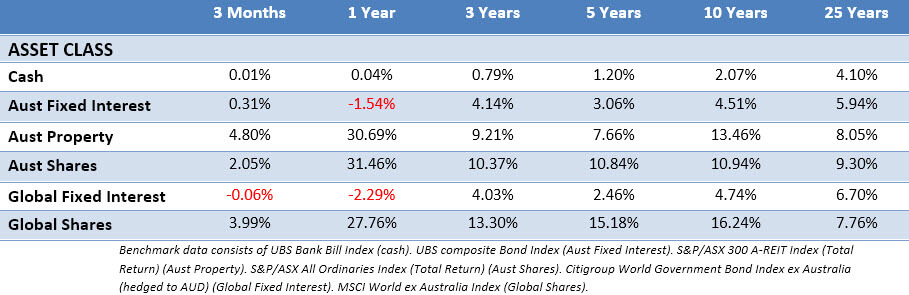
Global sharemarkets in Australian dollar terms were reasonably strong in Q3, albeit with some headwinds emerging in September, which is historically the worst performing month for equities. Yields rose in longer dated bonds in the US and UK, the 10-Year US Treasury yield edged higher from 1.47% to 1.50%, while the UK 10-year yield moved sharply upwards from 0.72% to 1.02%. Despite falling early in Q3, the Australian 10-year yield pushed upwards sharply with the release of Q2 inflation data to finish flat at 1.488%.

In the US, shares notched a positive return in Q3 with the S&P 500 up 0.58%. Strong earnings had lifted US shares in the run up to August, when the Fed Reserve struck a dovish tone, confirming its hesitance to tighten policy too fast. However, a double whammy of growth and inflation concerns late in the quarter saw US shares pull back in September and deliver their worst month since March 2020. Across the sectors, financials and utilities outperformed while industrials and materials struggled, although the September sell-off hit almost every sector. The exception was energy, as supply constraints drove natural gas and oil prices to highs.

Eurozone shares were mostly flat in Q3. The energy sector was one of the strongest performers, along with information technology with semiconductor-related companies due to the shortage in that space. Consumer discretionary companies struggled, with luxury goods area specifically under pressure with talk China could seek greater wealth redistribution, which could hit demand. Like elsewhere the quarter started positively, due to a series strong corporate results, but pulled back as through the quarter.

UK shares rose made gains in Q3, driven by a variety of factors. The clear sector winner was energy due to rising crude oil prices. Consumer discretionary companies struggled while consumer staples were strong. Merger & acquisition was again a theme. Wm Morrison Supermarkets takeover bid was recommended, US sports betting group DraftKings made a bid to acquire Entain, and US parts manufacturer Parker Hannifin made a bid for UK aerospace and defence equipment supplier Meggit. It was strong quarter for UK shares, outperforming all other major developed markets, with the exception of Japan.

In contrast to much of the world, Japanese shares were rangebound through July and August before rising in September to record a total return of 5.2% for Q3. While corporate results for the previous quarter were strong, sentiment was impacted in August as Toyota announced production cuts in September and October, due to the global shortage of semiconductors.

The rest of Asia and Emerging markets were negative in Q3. This was driven by the significant sell off in China, but also continued supply chain disruptions, worries over the implications of higher food and energy prices weighed on many emerging market countries. Brazil was the weakest market overall, as inflation took hold and its central bank responded with rapid fire rate rises. By contrast, the energy exporters generally outperformed, most notably Colombia, Russia, Kuwait, Saudi Arabia, Qatar and the UAE.

The Australian market (All Ords Accumulation) backed up its strong Q2 with another positive quarter. Transportation, consumer services, insurance and energy were the strongest performers. The strength in transportation can be attributed to the interest of superannuation and global pension funds in infrastructure assets such as airports. Sydney and Auckland airport shares were up sharply for the quarter, along with Qantas. The worst performer was the second largest sector, materials. The iron ore sell off hit BHP, Rio Tinto and Fortescue hard, the trio also went ex-dividend with big payments, but the juicy dividends couldn’t offset the price falls.


This material is provided for information only. No account has been taken of the objectives, financial situation or needs of any particular person or entity. Accordingly, to the extent that this material may constitute general financial product advice, investors should, before acting on the advice, consider the appropriateness of the advice, having regard to the investor’s objectives, financial situation and needs. This is not an offer or recommendation to buy or sell securities or other financial products, nor a solicitation for deposits or other business, whether directly or indirectly.
Filed Under: Uncategorized

August 20, 2021 by John Duncan

The Blind Leading the Blind

On the 4th of August, CommSec, Australia’s largest online broker released a statement. It began:

The limits on trades without a cash deposit are changing from 04 September, 2021.

In light of recent market volatility, CommSec is changing trading limits to help protect our customers and minimise risk associated with investing and settlement.

In the good old days, there was something known as T+3. You could buy a stock and your broker would give you 3 days to settle the trade, i.e. come up with the money. It provided an open window for retail traders to chance their arm on buying a stock, hoping it went up and then selling out before having to put down any money. If you were lucky and brave, you might have been able to scalp a profit. More recently, the T+3 became T+2 as the ASX changed its trading rules.

Same principle applied, but retail traders could still jump in and out of stocks on a short-term basis without needing to have much (or any) cash in their account. The more risk averse and experienced wouldn’t hold beyond the trading day, lest they woke up to a surprise the next morning. A poor announcement or a trading halt, which meant they couldn’t exit their position and would have to stump up the capital.

The first few words of the second sentence of CommSec’s statement were curious. Anyone who has been watching the market recently could tell you volatility has been low, especially in the past two months, so to make this change due to “recent market volatility” seemed strange. Unless you recall Commonwealth Bank’s half year result from February.

CommSec, the bank’s brokerage service, added more than 230,000 new users in the last six months alone as Australia experiences its own share of market mania. Seven in ten of those are trading via the normal app or the micro investment app CommSec Pocket, suggesting much of the growth is being driven by a younger demographic.

Putting two and two together, it would seem some of these new users have taken the opportunity to T+2 trade without having the money to settle. They’ve likely been caught out by a poor announcement which left them heavily down, or trading halt which left them unable to exit their position before settlement date. CommSec now wants more skin in the game. Prior to the announcement, Commsec had a $25,000 limit without needing a deposit for leading stocks (bigger/known) and $7,500 for non-leading stocks. They’ve cut them to $5,000 and $1,000 limits respectively.

Occasionally, posts have appeared on social media investment groups, where a panicked user asked what to do because they didn’t have money to clear a trade that went against them. While some thought these posts were people trying to wind the group up for attention, CommSec’s policy changes would suggest they were truthful. Some played a dangerous game and were caught with their pants around their ankles, and without the money to settle their trades.

With the pandemic lockdown turning investing into a video game for new entrants, it’s no surprise people have gotten themselves into trouble. The suggestion is a lot of it’s coming from social media influencers egging the naïve on. Something ASIC has some trouble dealing with, as noted when an ASIC manager spoke to a recent conference.

“There’s a fragmented nature when we’re talking about social media and the internet; there’s the scale of information that we have to monitor, there’s ease of access to that information and the rapid churn rate – these are considerations that make it a quite complex environment for us.”

“While social media can be okay as a means of getting background information. Use your judgement and think about risks like the fact that advice on social media may not be licensed, you might be getting information on something that is inaccurate.”

And:

“Those providing it might have interests in the advice, they might be promoting a certain product so that’s something to bear in mind.”

The Federal opposition was keen to weigh in on the matter, with Labor MP, Julian Hill suggesting

“Everyday Australians are being left to look to social media and TikTok influencers,” and “the minister doesn’t think this is a problem as it is no different to speaking to someone in the pub, but ASIC are concerned. These ‘influencers’ are taking kickbacks, that is what the Government is leaving people to, and it is a return to the bad old days of commission.”

While it’s opportunistic from the opposition, especially as they’ve never been friends of the professional advice community, the MP makes a good point. The person in the pub talking about stocks previously had an audience of one or two. Now some have an audience of several hundred thousand and it’s often not clear if they’re partnered with a stock or investment service for promotion.

More than ever it’s easy to get online and pose like an expert. If someone gathers enough of a following, companies will want them to push their products. Finding unbiased, common-sense information isn’t becoming any easier.

Which brings us to a question posted to an online financial independence forum recently. A person had concluded they and their partner were ready to delegate their affairs to a financial adviser, so they asked how should they go about finding one? How useful were the answers to their question? What followed was the equivalent of an online pub brawl.

Without knowing a thing about the couple, several said they shouldn’t bother working with an adviser and just do it themselves. Two people got into an argument about active and index management, while others got into an argument about investment platforms, with one claiming they were designed to rip off clients – if only fraudster Melissa Caddick’s clients had known about the value of having their funds with a verifiable third-party platform!

The person asking the question was likely more confused after reading through the mess.

There’s never been so much freely available information, meaning information has never been more valuable and worthless at the same time. The right information – priceless. The rest? Not so much

Always consider the source.

This represents general information only. Before making any financial or investment decisions, we recommend you consult a financial planner to take into account your personal investment objectives, financial situation and individual needs.

Filed Under: Uncategorized

July 15, 2021 by John Duncan

2021 Q2 June Quarter Review

Economic Overview

Attention turned to vaccinations and reopening economies in the second quarter of 2021, by the end of the quarter over 3 billion vaccine doses had been administered globally. There are now strong indicators of a robust and lengthy economic expansion ahead. Around the world there are now businesses desperate to hire new employees, millions of consumers with money burning holes in their pockets, and ongoing fiscal and monetary support from governments and central banks.

In the US, the positive news around COVID was vaccinations. While President Biden had set a goal of 70% of all adults vaccinated by July 4, analysis by The New York Times in late June suggested the US would fall short, with around 67% of adults partially vaccinated. The Centers for Disease Control and Prevention (CDC) figures showed 45% of Americans had been fully vaccinated near the end of Q2. The laggards were those aged between 18 and 26. The negative news was the Delta strain of the virus. Delta is more contagious and according to the CDC was accounting for over 20% of US cases at the end of June.

The increasing vaccination rate is contributing to the resumption of travel and dining out across the US. Various data points have shown restaurant traffic back to, and even above, pre-pandemic levels. Air traffic remains 24% down and hotel occupancy down 10%, but significant progress has been made across the quarter. Since March, the US economy added 1,702,000 jobs and net growth in payrolls since last May 2020 totals 15.6 million. In late June, President Biden also secured a deal on a $1 trillion infrastructure package to upgrade roads, bridges and communications networks.

Late in the quarter there was some panic around potential responses to inflation as the Federal Reserve’s Open Market Committee unveiled unexpected rate hike projections for 2023. These were accompanied by increased inflation and economic projections for 2021. However, Fed Chair Jerome Powell attempted to dampen the hawkish forecasts by noting much progress is still needed and future changes to the asset purchase program will be “orderly, methodical and transparent.”

In the Eurozone, the pace of vaccine roll-out accelerated as many countries saw COVID cases fall through the quarter. Falling cases combined with increasing vaccination rates saw social and economic restrictions loosen. Economic data was positive and pointed to a strong rebound in Q2. The flash Markit eurozone composite PMI rose to 59.2 in June, this was its highest level since 2006. Eurozone inflation was estimated at 1.9% in June, down from 2.0% in May. The European Commission signed off on the first of the national recovery plans which will receive funding from the €800 billion Next Generation EU fund. This forms part of the largest stimulus package ever in Europe, a total of €2.018 trillion. The first countries to have their spending plans approved under the Next Generation fund were Spain and Portugal.

In the UK, the vaccine rollout stood at 65% of the population with at least one dose by the end of Q2. The Delta strain of the virus saw the UK government postpone the final easing of lockdown restrictions until 19th July. Economic data continued to highlight a robust recovery. Retail sales rose by 10% in May compared to the pre pandemic measure of May 2019. The Bank of England (BoE) increased its GDP growth forecast for 2021 to 7.25% from the 5.00% it predicted in February. The Bank of England left monetary policy unchanged in June and sought to calm fears over rising inflation. The Bank acknowledged that inflation would rise but suggested the surge in prices was transitory and should not affect monetary policy.

In Japan, vaccination rates increased in May getting past some of the hurdles seen in the previous quarter, but were still slow. Though infections were lower than in many other countries, cases continued to grow, leading the Suga government to delay lifting the state of emergency until June 20. Industrial production was weaker than expected, the primary reason being a slowdown in auto production caused by the global shortage of semiconductors.

China saw factory activity fall in June as raw material costs and the semiconductor shortage began to bite. While year on year GDP growth was 18.3% in Q1, this was expected to fall back into single digits in Q2 as most of China’s recovery has already occurred. Chinese manufacturing PMI slipped to 50.9 in June versus 51.0 in May. Consumer spending has been sluggish, with figures showing household expenditure lagging disposable income as Chinese consumers continue to save.

Emerging market countries saw a particularly severe third wave of covid infections. Vaccinations generally lagged developed markets as emerging market countries struggled to procure developed country vaccines. Despite spike in virus cases, the Brazilian economy rode the booming global demand for iron ore and copper, along with agricultural commodities. The Russian economy benefited from agricultural demand despite ongoing political frictions with western countries. Higher oil prices were also supportive in Russia, along with Saudi Arabia.

Back in Australia, data released in June showed the economy grew 1.8% for Q1, with year-on-year growth at 1.1%. The household saving rate also increased to 12.2% showing some caution from consumers, but also a capacity to spend. Q2 also coincided with the end of the JobKeeper program, with the economy seemingly having no problem digesting the withdrawal of support. The unemployment rate fell to 5.1% in May. On the virus front, Australia was somewhat of a victim of its own previous success when it came to getting the population vaccinated. The reports of blood clotting from AstraZeneca recipients in Q1 led to public hesitancy and changing advice around the vaccine. Notably, there was no countrywide vaccination awareness campaign from the Federal Government, while PM Scott Morrison suggested getting vaccinated “was not a race”, indicating the government may have been at ease with a longer-term border closure.

In its June minutes, the Reserve Bank noted it would “maintain highly supportive monetary conditions until its goals for employment and inflation were achieved.” And it “would not increase the cash rate until actual inflation is sustainably within the 2 to 3 per cent target range” something the board highlighted would require significant wages growth to occur.


Market Overview

Asset Class Returns

The following outlines the returns across the various asset classes to 30th June 2021.

Global sharemarkets delivered strong returns in Q2, while yields fell in longer dated bonds in the US and UK, reversing some of the sharp upward moves of Q1. The 10-Year US Treasury yield declined from 1.74% to 1.47%, while the UK 10-year yield fell from 0.88% to 0.72%.

In the US, the S&P 500 and NASDAQ reached a new all-time high in late June, with nearly all sectors notching gains over the quarter. The tech titans such as Apple, Alphabet (Google) and Microsoft made strong gains over the quarter. Notably, Facebook joined Apple, Microsoft, Amazon, and Alphabet (Google) in the exclusive $1 trillion market-cap club. By sector, energy, IT, communication services and real estate were amongst the strongest areas of the market. Utilities and consumer staples were the laggards.

Eurozone shares advanced in the quarter, supported by a strong corporate earnings season and an acceleration in the pace of vaccine roll-out in the region. The top performing sectors were defensives, areas such as consumer staples and real estate, which had lagged in Q1 as investors focused on more economically sensitive areas of the market. Information technology was also strong, while utilities and energy were laggards. As noted, earnings for Q1 were robust across the board, with healthcare the exception.

UK shares were largely driven by lower valued and economically sensitive sectors during April and May and as sentiment improved, global investment managers reported being “overweight” the UK for the first time since 2014. However, June was a different story amid a rise in Covid-19 infections and falling inflation expectations. Defensive large cap companies were resilient in June, particularly healthcare and consumer staples. Energy also performed well in June, while financials were poor.

The Japanese market fell during Q2 despite a decent corporate results season where the majority of companies reported inline, or slightly ahead of expectations. The number of companies reporting profits below expectations has been significantly lower than normal.

The rest of Asia was mostly positive in the Q2 as investors were optimistic about economic normality. However, returns were tempered towards the end of the quarter due to a resurgence of Covid-19 infections and lockdowns due to the Delta strain. The stronger US dollar also weighed on June returns. The Philippines was the strongest index market in the quarter, while Taiwan and India also achieved positive gains during the quarter. By contrast, Pakistan, Indonesia, and Thailand all struggled as rising Covid-19 infections weighed on their respective markets.

The Australian market (All Ords Accumulation) notched a 8.66% return for the quarter. Sector strength was similar to the previous quarter, coming from financials and consumer discretionary, although most sectors posted gains. Over the financial year, consumer discretionary led the way with 42% return, followed by financials at 39% and financials 35%. Utilities continued their poor run in Q2 and were the poorest performing sector in the year to June 30, down 23%.


The Easy Money…

One of the ongoing challenges of investing is to set aside the distractions of the “here and now” to focus on the long term where true wealth is usually made. Not only do investors have to digest real events that seem concerning in the moment, but they also need to block out the commentary from market watchers that can shape opinions about what the future holds.

One of the regular lines trotted out in the financial media is how “the easy money has been made”. We’ve plotted several of these calls on a chart that tracks the growth of $1 invested in global stocks over the past 12 years. For some more context, we’ve added in a few concerning historic events in red. $1 in January 2010 turned into $5.22 at the end of June 2021. This, despite calls “the easy money had been made” 13 times.

While there’s no easy money in financial markets, the easiest money is often made by looking beyond concerns about the present, ignoring narratives about the future, and doing nothing.


This material is provided for information only. No account has been taken of the objectives, financial situation or needs of any particular person or entity. Accordingly, to the extent that this material may constitute general financial product advice, investors should, before acting on the advice, consider the appropriateness of the advice, having regard to the investor’s objectives, financial situation and needs. This is not an offer or recommendation to buy or sell securities or other financial products, nor a solicitation for deposits or other business, whether directly or indirectly.

Filed Under: Uncategorized

June 4, 2021 by John Duncan

Inflation or Not?

From pooches to second-hand cars, to homes in regional areas, to ground beef in the supermarket. Everyone has a story about how their money is buying less.

Eight years ago, you could get this good girl delivered to your front door for $1300. Today, or more precisely back in January, she went for $7990, and you had to front for delivery. While that’s a jump over 8 years, a good part of it has occurred recently. The pandemic had a spike of people wanting dogs. Breeders can only supply so many dogs, so they had the luxury of pricing according to demand.

Which is essentially Inflation. A supply constraint which leads to a shortage of labour and products, resulting in a higher bid for labour and products and higher prices. The gauge we are given is the Consumer Price Index figure.

There are a lot of theories about what’s included and not included (and why), and not sure if miniature spoodles make up part of Australia’s CPI number, so anecdotes about random observations are interesting, but not that useful. You can only work off the data you’re gifted, no matter how much you dislike it. At the last print in Australia, it was running at 1.1% annually. In the US, where there are bigger concerns, it hit 4.2% in April which led to a small ruckus on world markets in recent weeks.

We know where inflation is, but anyone claiming they know where inflation is going is guessing. There is no shortage of opinions about inflation’s direction.

Macquarie strategist, Viktor Shevets has a theory about why inflation will remain low, at least in the US. In a recent podcast Shevets highlighted 60% of the U.S. private sector economy is intangible assets such as software, patents, brand equity and databases. Previously, tangible assets such as plant equipment and machinery comprised the majority of wealth.

Previously when demand increased in this more tangible based economy, price increases were slow to be addressed, as supply, such as constructing factories and then hiring workers to fill them took time. Software and pharmaceuticals are quicker to respond, meaning demand-based price increase aren’t as common. There’s rarely a supply constraint in software.

Shevets also argues the flexibility of the labour will prevent inflation, with 20 to 25% of people employed in the gig economy. He suggests workers will move quickly to fill sectors requiring increased production and this will keep a lid on wages in contrast to the past.

Noting this, after a spike in 2020, US hourly earnings growth has fallen to the lowest level in years. Back in Australia, wages growth is still nearing 20-year lows. At the same time, we’ve heard plenty of screaming from business and industry groups who have become overly reliant on groups like international students for staffing, and in some instances reliant on paying them under the table at a reduced rate, which contributes to that anaemic wage growth.

With the borders closed we haven’t seen wage inflation show officially, yet the agitating to open the borders or grant special exemptions continues furiously from businesses claiming they can’t find workers. On that front, if there is no spike in wage growth, there may not be a labour shortage, just a shortage of wages.

The pandemic has seen many people hunker down in their own fortress. Spending up big on durable goods around their house as their hair and beards grow, instead of taking holidays, eating out, seeing a show, movie, or getting a haircut. When the demand for durable goods increases sharply, it results in shortages and supply constraints that drive up prices. This set of circumstances seems unlikely to last. Eventually people will be vaccinated, and their spending will transition from durables to services.

The big question. If inflation does come raging back, how does that affect your portfolio?

The last big occurrence of inflation was back in the 1970’s and 80’s. Anyone around then would remember double digit spikes. The prospect of double-digit inflation seems outlandish given where we currently are, but it’s still useful to get an understanding of how assets have performed. The longest data available across various asset classes is in the US. We’ll only focus on the 70’s because that’s when inflation broke out, while in the 80’s you might say it was an embedded part of life.

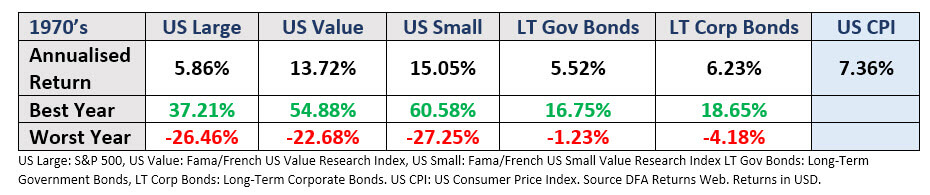
Here’s how the 70’s looked:

For stocks it was a volatile decade, note the best and worst years. On average across the three stock categories noted, the 1970’s were more volatile than either the 1960’s or 1980’s and stocks were brutalised across 1973/74 when inflation really broke out. Like always an investor had to hold on because it was followed by a massive rally, particularly in small and value stocks.

Inflation will prove frustrating when holding longer dated bonds. In 1974 and 1979 when inflation hit double digits, long term corporate bonds were negative and long-term government bonds were also negative in 1979. Both lagged the CPI figure as a measure of inflation. Stocks, as viewed by the major indexes such as the S&P 500 did terribly. 5.86% looks ok, but then add in inflation at 7.36% and you’ve gone backwards.

This is why you will often hear screaming about gold, hard assets and commodities as the thing to hold if inflation takes off. The comparison will be made with an index such as the S&P 500 and how poorly it performed during the 1970’s. If you want to add a little nuance into the discussion, take a look at US Small and US Value stocks, both kept an investor well ahead of inflation over the decade.

Inflation won’t be pretty, but is it coming? We don’t know. Our only conclusion to draw from this is the same as always. Remain diversified and have a portfolio tilt towards value and small to capture those factors when they emerge. They may play a part in ensuring your portfolio isn’t left behind. Otherwise, you could always breed miniature spoodles.

This represents general information only. Before making any financial or investment decisions, we recommend you consult a financial planner to take into account your personal investment objectives, financial situation and individual needs.

Filed Under: Uncategorized

May 12, 2021 by John Duncan

Federal Budget 2021/22

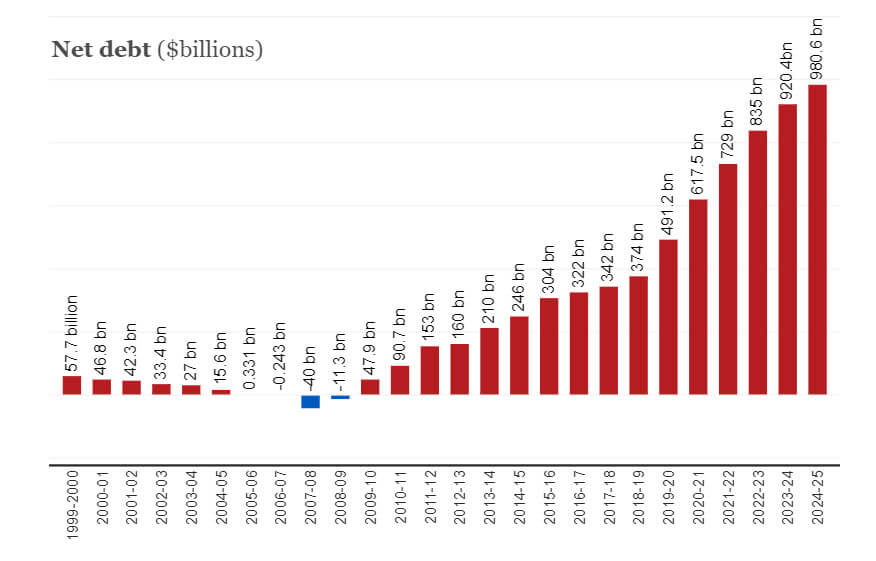
The first post COVID federal budget has been released and while the numbers are slightly better than what was previously expected, it wasn’t a budget where the reins were pulled. Given the spending, Labor must be wondering what to do with themselves. On a surface level, the LNP are seemingly occupying more of what is often marketed as Labor’s bigger spending space. Where this leaves Labor ideologically, as the LNP projects budget deficits for years with net debt pushing $1 trillion dollars, who knows?

With an early election supposedly coming up off the back off this budget, there is plenty of space if Labor want to rebrand themselves as fiscal conservatives!

As former PM Tony Abbott once said, “I just want to assure people this is a debt and deficit disaster that this government is grappling with.” That was when net debt stood at $210 billion in 2014, add seven years and an extra $500 billion and any talk of a debt and deficit disaster has evaporated.

The idea of all the debt is to help grow our way out of the problem. This will be the sport to watch. Some commentators are suggesting it is not targeted in the right places, so growth isn’t likely to be strong.

On this issue, Treasury has not substantially amended wage growth forecasts, expecting 1.25% this financial year, and 1.5% next financial year. Yet Treasury has forecast the consumer price index to rise 3.5% this financial year up from its previous forecast of 2.25%, and 1.75% next financial year up from its previous forecast of 1.5 per cent.

Keen eyes will note that will amount to a pay cut in real terms.

Others are worried about a breakout in inflation. Veteran business journalist Robert Gottliebsen who has been speaking to all and sundry in the business community, suggests that businesses he’s speaking to are being forced to raise wages sharply to secure employees. He offers this warning:

“If you believe Treasury and the Reserve Bank then there is no need to lock in rates on borrowing. But if I am right interest rates will rise in 2022 so its urgent that highly indebted households borrow for as long a period as they can arrange at a fixed rate. The same applies to companies.”

As always, forecasting is an unknown. Someone will be right. Someone will be wrong.

On to the relevant points of note from the budget.

Income Tax

Low- and middle-income workers: Tax cuts of up to $1080 for individuals, or $2160 for dual income couples, for those earning between $48,000 and $90,000.

Employee share schemes: Leaving an employer will no longer be a taxing point for employee share scheme entitlements. This means that tax deferral for the employee share scheme entitlements will continue until forfeiture conditions have passed and shares are held that are freely able to be sold.

While the tax cut is being promoted by the Government and many in the media who are asleep at the wheel, don’t fall for it. There are no tax cuts. The Low and Middle-Income Tax Offset (LMITO) is only being maintained at the current level. It was due to expire and increase taxes. A big change on the share schemes, Australia was the only jurisdiction in the world where an employee was taxed on company shares granted as an income package the moment the employee left the company. This meant someone often owed tax on something they hadn’t yet received a benefit from.

Superannuation/Retirement

Downsizing: Australians aged 60 and over will be eligible to make post-tax contributions of up $300,000 into superannuation per person when they sell their homes. Previously eligibility was age 65 and over.

Work Test: The work test will no longer apply to those aged 67-74 when making non-concessional or salary sacrificed contributions to superannuation. This age group are now also able to access the non-concessional bring forward arrangement, subject to eligibility.

Minimum Income Threshold: Previously there was a $450 monthly minimum income threshold before the Superannuation Guarantee was paid by their employer, this has been abolished. This means those earning under $450 a month will now receive superannuation from their employer.

Pension Loan Scheme Lump Sums (PLS): The PLS is a reverse mortgage type loan offered by the Government and designed to assist older Australians to increase retirement income via the equity in their Australian property. Users of the scheme could receive fortnightly payments accrued as a debt against their property. Now there will be the option of two lump sums of up to 50% of the Age Pension in a 12-month period.

Residency requirements for SMSFs: The Government will relax residency requirements for SMSFs by extending the central control and management test safe harbour from two to five years for SMSFs. This will allow SMSF members to contribute to their superannuation fund if overseas pursuing career opportunities.

All are options that should offer more flexibility around retirement and retirement planning.

Seniors and Home Care

As a response to the Royal Commission into Aged Care the government has announced $17.7 billion in funding for the aged care space.

Of note, an additional 80,000 Home Care Packages over two years. Extra funding to ensure compliance and a star rating to allow Aged Care recipients and their families to compare providers on performance, quality, and safety. Funding for informal carers. A $10 daily supplement for aged care residents for care and nutrition. And further measures to increase the size and skills base of the age care workforce.

Hopefully this will go someway to increase dignity and choice in the aged care space.

New Homeowners

New Home Guarantee: The Government is providing a further 10,000 places under the New Home Guarantee. This is for first home buyers either building a new home or purchase a newly built home with a deposit as low as 5%.

Family Home Guarantee for single parents: This is for single parents regardless of whether they have previously owned a home or not. From 1 July 2021, 10,000 guarantees will be made available over four years to eligible single parents with a deposit of as little as 2%, the government will guarantee the difference up to 18%. There are property price caps depending on location.

First Home Super Saver Scheme: Introduced in the 2017/18, this scheme allows people to save money for their first home inside their super. The Government will increase the maximum amount of voluntary contributions that can be released under this scheme from $30,000 to $50,000.

Australia has housing affordability challenges in various locations around the country and the reaction to COVID has essentially exported unaffordability far and wide as many people departed cities. The incentives for new housing are good, but buy side incentives like 2% down government backed mortgages do nothing to alleviate the problem and they are likely an accident waiting to happen with rates at record lows. The Super Home Saver Scheme is being reported in the media as first home buyers being able to take $50k from their super, which isn’t exactly correct, it is from voluntary contributions.

Business

Temporary full expensing: The temporary investment tax incentive has been extended 12 months until 30 June 2023. Business now has additional time to utilise the incentive. Businesses with a turnover up to $5 billion will be able to deduct the full cost of eligible assets purchased for their business, including the cost of improvements to existing assets.

Temporary loss carry-back provision: Companies will now be permitted to carry back tax losses for an extra 12 months from the 2019/20, 2020/21, 2021/22, and now 2022/23 income years to offset previously taxed profits in 2018/19 or later income years. Again, this applies to businesses with a turnover up to $5 billion.

ATO Dispute Mediation: A new umpire will also be introduced to mediate in disputes over debt between the Australian Taxation Office and businesses with a turnover of less than $10m.

As always, to ensure to you make the most of your money, we will offer advice on how to best apply it to your circumstances.

This represents general information only. Before making any financial or investment decisions, we recommend you consult a financial planner to take into account your personal investment objectives, financial situation and individual needs.

Filed Under: Uncategorized

October 29, 2020 by John Duncan

Election Result Irrelevant, but Vital

It is a week out from the US Presidential election.

We’ve deliberately avoided the election until the very last moment. Why? Its lack of importance. We hear ‘this is the most important election of our lifetime’ almost every election. On some issues, maybe it is. When it comes to investing, it rarely is. Nor should an election ever be regarded as something to focus on.

If an investor is perpetually scanning the horizon for the next event, then they are perpetually distracted by things they can’t control. It isn’t conducive to disciplined investing. Agonising and handwringing over this election, or any other election, is pointless. Like a kidney stone, there is the possibility of short-term pain, but it will pass. There will be another one in four years’ time. The election, that is.

Capitalism will continue to function. Companies still want to make money. They will adapt to whoever is in power and whatever the policies are. Investors will continue to be rewarded over the long term for supplying their capital. This is why any time you see a chart or table showing investment returns during various periods of government, there is no discernible better party or leader. Economies and markets generally get on with it.

A suggestion to the contrary is full of bunk.

Market talk around outcomes revolves around the various sides wanting some validation for their guy or team. We know what history says: no clear better party. And we don’t know what the future is, so forecasting a market response is foolish. Both sides have negatives and positives. Their election or re-election will send money scuttling around to favoured industries. Some sectors will prosper more than others.

Biden rolling back Trump tax cuts on corporations won’t be great. Neither will treating capital gains and dividends as regular income. Increase the marginal rate on people earning over $400,000. There are policies and there is expediency. An economic recovery will need to be well underway before any big changes. Most importantly, a Democratic win will likely bring another massive stimulus package.

Trump equals tax cuts ongoing, China-bashing and deregulation. Likely winners (or those getting a hand) will be oil & gas, financials and defence. Infrastructure and clean energy will do better under Biden. Biden might look at a lock to eradicate the virus. Financially painful. Trump’s plan won’t change. Letting it rip while bragging he beat it. More casualties.

Last time, prominent media personalities and even economic laureates were prognosticating about the end of days because of Donald Trump. Market ruin and economic armageddon. Neither occurred. Now Trump and his supporters use the same lines on Joe Biden. See how this works?

Either result should be considered business as usual.

The key word is ‘result’. The pandemic has done considerable damage meaning more stimulus will come. Financial markets will appreciate this. The current argy bargy over a current stimulus bill passing highlights what markets don’t like: nonsense and delay.

This prompts the key concern about this election. The concern is not a victory or loss for Biden or Trump, but a flap about the outcome. There is only one outcome an investor should want to see: the loser quickly conceding before making a swift exit into the sunset with the wind at their back.

President Trump has been making noise about voting fraud and ‘will he’ or ‘won’t he’ accept the result? What financial markets do not want to see is Trump putting on a tantrum about the outcome. If there is a very clear winner on the night, there will likely be a relief rally.

The alternative?

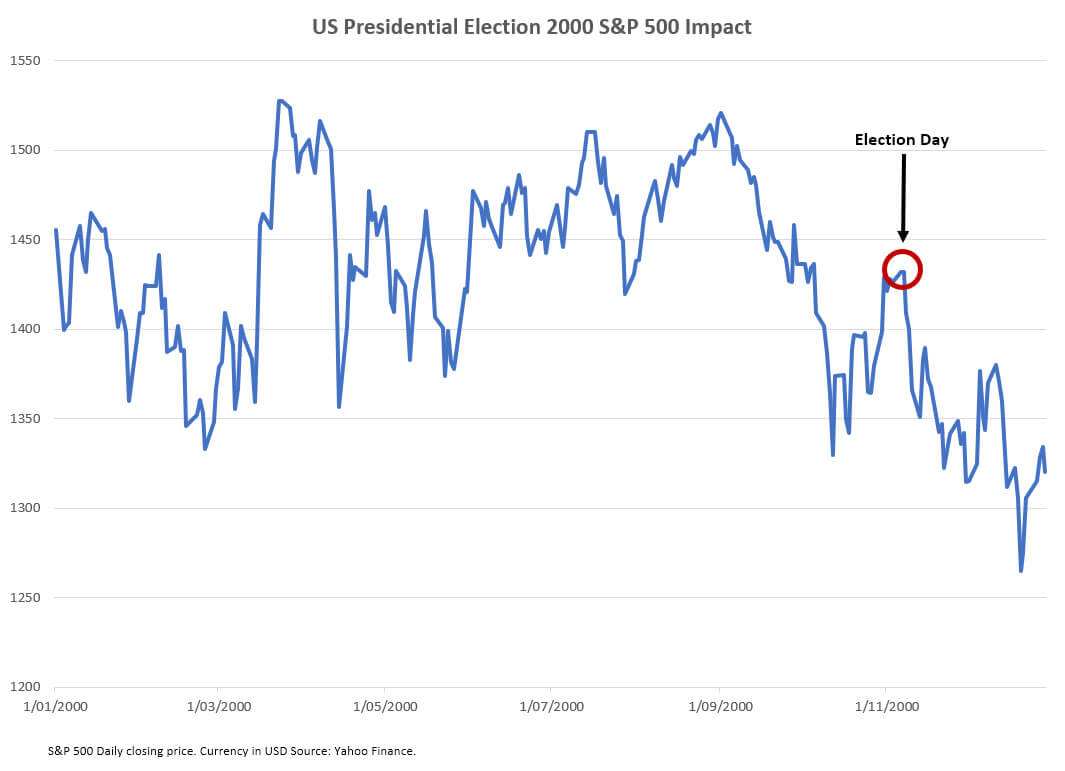
Going off the only real evidence we have, 2000’s Bush vs. Gore fiasco. The market does not like a contested election.

2000 was not the greatest year on the S&P 500. Calendar year, until election day on November 7, it was down 1.65%. It may even have been poised to finish the year on a positive note. With the state of Florida undecided on election night, that thought went out the window.

What followed was 36 days of turmoil as the election result hung on Florida. As the result was so close, it prompted a recount. The recount was a stop/start affair as courts at every level were involved in an attempt to determine voter intent on ballots. Eventually it ended in the Supreme Court. The recount was halted.

There was a minor rally in December after the chaos was sorted, but not enough to erase the losses. While this was all painful for US investors, back in Australia investors with diversified portfolios sailed through and our market actually held up through the chaos. The ASX returned 1.12% for November and 3.68% for the year.

No matter who you want to win, the best result is an unambiguous outcome.

This represents general information only. Before making any financial or investment decisions, we recommend you consult a financial planner to take into account your personal investment objectives, financial situation and individual needs.

Filed Under: General, Investment, Uncategorized

October 16, 2020 by John Duncan

2020 September Quarter Review

Economic Overview

As to be expected, the ongoing and dominant economic and market theme remains COVID-19. More so than ever, with COVID present no quarter will be quite like the previous. While Q1 was one of steep decline and pain, Q2 was sharp recovery and euphoria, while in Q3 markets took a slightly more subdued, albeit positive direction. Accommodating monetary and fiscal policy kept markets happy.

In the US, the economy continued something of a recovery. The Federal Reserve noted it will use average inflation targeting in setting the interest rate, allowing for overshoots in inflation. This means the Fed will allow inflation to move above 2% before it responds. The Fed’s projection path of interest rates indicates it will likely hold rates around 0-0.25% into 2023. The US unemployment rate dropped to 8.4% in August, down from 10.2% in July, while labour force participation also improved. Industrial production rose for the fourth consecutive month in August, but at a much lower rate than earlier in the summer.  Similarly, retail sales increased in August, but again at a slower rate and below expectations.

Source: RBA 2020

In the EU, a €750 billion fund was approved to help member states recover from the pandemic. It comprises €390 billion of grants and €360 billion of loans to be distributed among member states. Unfortunately, Covid-19 infections rose rapidly in several countries throughout the quarter, particularly in Spain and France. In response, restrictions to contain the virus were announced. Although these restrictions were localised, opposed to the countrywide restrictions witnessed in the first phase. Various European countries, including Germany, extended furlough schemes designed to support jobs through the crisis. Business activity stalled in September with the flash purchasing manager’s index (PMI) falling to 50.1, down from 51.9 in August. 50 is the level that separates expansion in business activity from contraction.

In the UK, Brexit reared its head again with the potential for a disorderly exit beginning to flare. Not far behind were concerns for a second wave of COVID-19 infections, this saw the localised restrictions imposed in the North, similar to those imposed in some of Europe.

In Japan, the dominant news story was the resignation of Prime Minister Shinzo Abe due to a long-standing health issue. Abe claimed the record as the longest continuous Japanese Prime Minister, then resigned four days later, on August 28. Yoshihide Suga, the Chief Cabinet Secretary, quickly emerged as the frontrunner, being confirmed as PM on September 16. Data for the second quarter showed Japan’s economy recorded a decline for the third consecutive quarter, with the Q2 decline of 7.9% being the largest in GDP data going back to 1955.

In China, economic data signalled ongoing recovery and Q2 corporate earnings results were positive. Q2 GDP growth rebounded to 3.2% year-on-year, after a fall of -6.8% in Q1, and was stronger than expected. However, tensions with the US escalated, including new restrictions on Chinese telecoms company Huawei, and as President Trump signed an executive order to prevent US companies from doing business with TikTok and WeChat. In India, good monsoon rains were supportive, while towards the end of the quarter the government passed agricultural and labour reforms. This was despite further increase in the number of daily new cases of Covid-19, and as tensions with China on the Himalayan border persisted

In Thailand, the lack of improvement in the tourism sector was a drag on the economic recovery. In Indonesia, Covid-19 cases rose and had an increasing impact, especially in rural areas. As a result, tighter restrictions were brought in for Jakarta.

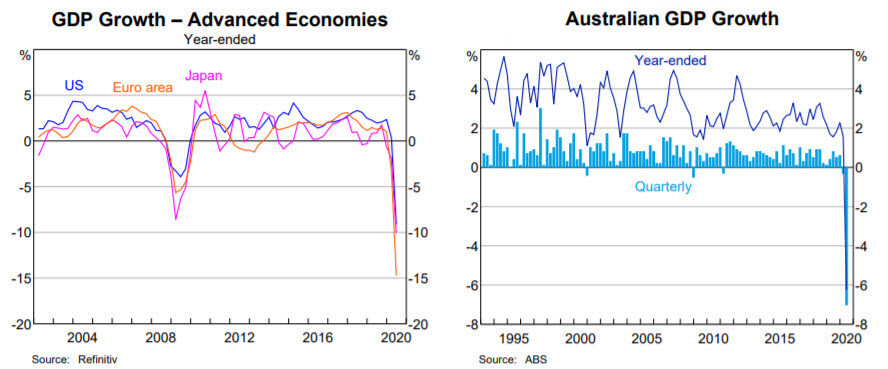
Back in Australia, the fallout from COVID-19 became evident in headline economic data from Q2. A 7% decline in the three months to June following on from a 0.3% decline in the March quarter, confirming Australia’s first recession since the 1990’s. It was also the largest fall in quarterly GDP since records began in 1959. With borders still essentially shut to most overseas visitors for the foreseeable future the government was looking at ways to revive the economy.

One of the more interesting announcements was the Australian government flagging the removal of responsible lending laws, something many commentators flagged was a strange pursuit, given the country has the second highest household debt in the world. When it came to monetary policy, the RBA left the cash rate at 0.25%, noting in the September release that it expects inflation “between 1 & 1.5% over the next couple of years” and it will not increase the cash rate until progress is made towards full employment and  inflation is sustainably between the 2–3%.

Market Overview

Asset Class Returns

The following outlines the returns across the various asset classes to the 30th September 2020.

Global stocks gained in Q3 but regional performances diverged with Asia and the US outperforming Europe and the UK. Government bond yields were little changed, however, corporate bonds enjoyed a positive quarter. As we noted last quarter government and central bank stimulus are playing their part, while ultra-low rates on cash and bonds means some investors are forced to take additional risk, which may be more supportive of higher stockmarket valuations.

US stocks gained in Q3, but struggled across September amid a resurgence of Covid-19 cases and political fighting over refreshed fiscal stimulus measures. Worries also grew over language used regarding a smooth transition of power if President Trump loses his re-election bid. Consumer discretionary areas, such as restaurants and appliances or apparel retailers performed well. Distribution companies were stronger and helped lift the industrials sector, while several airlines still facing headwinds from languishing passenger numbers, offered slightly positive returns. Energy companies remained weak on poor expectations for fuel demand.

Eurozone stocks were basically flat over the quarter. Economic data slowed over the quarter and worries took hold over sharply rising Covid-19 infections in many European countries. The energy and financial sectors saw the largest falls while materials and consumer discretionary advanced, automotive companies also generally fared well.

UK stocks lagged behind other regions during the quarter. This extending their year-to-date underperformance due to the market’s significant exposure to stocks in the oil and financial sectors. Performance was further undermined when UK focused areas of the market were hit in September with the re-imposition of localised restrictions and fears about the impact of these on the UK economy. Pound strength against a weak US dollar weighed on large UK companies with exposure to international markets.

Japanese stocks performed strongly with the Topix Index recording a 5.2% total return. This was despite a gradual strengthening of the yen against the US dollar over the period. Although corporate profits are still under pressure, the earnings season which concluded in early August, brought more positive surprises than many expected.

Asia ex Japan stocks recorded a strong return in Q3, led by Taiwan, where IT sector stocks underpinned gains. India, South Korea and China all posted double-digit returns and outperformed the MSCI Asia ex Japan index. Emerging market equities registered a robust return in Q3, aided by optimism towards progress on a Covid-19 vaccine and ongoing economic recovery. US dollar weakness proved supportive. The MSCI Emerging Markets Index increased in value and outperformed the MSCI World.

In Australia, the ASX managed a positive total return, despite some of the largest companies such as the big banks, BHP and CSL finishing slightly lower. Darlings such as Domino’s and buy now pay later company Afterpay continued to power on. The strongest performing sectors were consumer discretionary and information technology. This seemingly still reflects stimulus and early superannuation release sloshing around the economy, while IT is still benefiting from technological changes as workplaces adapt to various COVID related changes. Energy slumped further, as it did elsewhere across the globe.

From an Australian perspective looking globally, unhedged international stocks again trailed their hedged counterparts as the Australian dollar strengthened with the recovery. International small caps trailed their larger counterparts over the quarter, something that has become a theme for much of the last decade. A similar theme has emerged in the laggard value space. When will these risk premiums return to favour? Unsure, but they can never be ignored. That’s why they’re called risk premiums because they’re not always present. There’s always the next quarter.


Additional material sourced from Schroders.

This material is provided for information only. No account has been taken of the objectives, financial situation or needs of any particular person or entity. Accordingly, to the extent that this material may constitute general financial product advice, investors should, before acting on the advice, consider the appropriateness of the advice, having regard to the investor’s objectives, financial situation and needs. This is not an offer or recommendation to buy or sell securities or other financial products, nor a solicitation for deposits or other business, whether directly or indirectly.

Filed Under: Uncategorized

October 7, 2020 by John Duncan

2020/21 Budget Review

The delayed and momentous 2020 Federal budget has been handed down. It contains some amazing figures. The normally fiscally conscious Liberal Nationals have turned spendthrifts in a bid to lift the country out of the COVID-19 induced recession.

It wouldn’t be a budget without heroic assumptions and the biggest in this budget is the assumption there will be a COVID vaccine next year, along with the majority of Australians being vaccinated. It also assumes growth will be running at 4.25% and unemployment will be down to 6.5 per cent by the end of 2022.

Another big assumption: everyone will run out and spend. The consumer and business, that’s what the government wants.

Notably, there doesn’t seem much additional infrastructure spending which one might assume would be the cornerstone of a budget attempting to lift a country out of recession. Here the hope is tax cuts, business asset write offs and hiring incentives will do the heavy lifting. While the over relied upon golden goose of population growth has disappeared. As Australia has been propping up growth by way of immigration for some time, how the economy performs without it will be interesting.

What we have is a budget deficit of $213 billion, a likely decade of deficits and national debt passing $1 trillion.

That’s the grim stuff, onto the good stuff and what it means for your bank account.

As always to ensure to you make the most of your money, we will offer advice on how to best apply it to your circumstances.

Income Tax

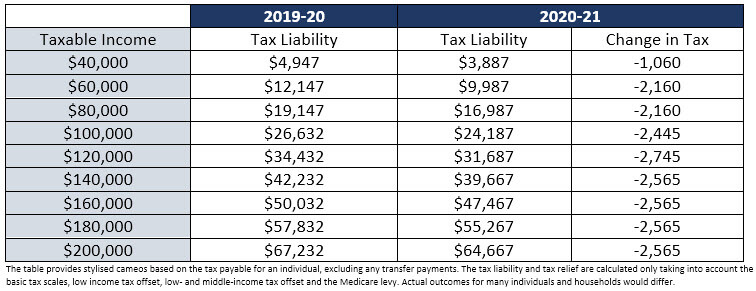
Various thresholds and offsets are changing, with the ‘Stage 2’ legislation from last year’s budget scheduled to occur from 1 July 2022 brought forward and backdated to 1 July 2020. Positively, this leaves 11 million taxpayers with extra disposable income, with more than 7 million Australians receiving tax relief of $2,000 or more this year. We’ll just focus on the outcome overall in the table below. This should mean tax changes are reflected in pay packets some time later in the year when business payroll systems adjust.

How it looks for this financial year

Social Security Stimulus

Those on Age Pension, Disability Support Pension, Carer Payment, Carer Allowance, Family Tax Benefit, or Pension Concession Card Holders, Commonwealth Seniors Health Card holders, and Eligible Veterans Affairs payment recipients and concession card holders will receive $500 over two $250 cash payments. These will be paid in December 2020 and March 2021. Positively this leaves those on lower payments with some disposable income to be spent.

Superannuation

The ATO will develop systems enabling new employees to nominate a MySuper fund through the YourSuper portal. This will also provide an online comparison tool.

Superannuation members will have their account ‘stapled’ to avoid the continual creation of new accounts when changing employers. By 1 July 2021, if an employee doesn’t nominate an account when starting a new job, employers will pay their super contributions to their existing fund. A person can maintain multiple funds, but by choice.

APRA will benchmark MySuper products based on net investment performance. Funds underperforming over two consecutive annual tests will be prohibited from receiving new members until they cease underperforming. This will be extended to non-MySuper products from1 July 2022. Underperforming funds would need to notify members and refer members to the YourSuper comparison tool.

The account stapling is a positive and will cut down on money wasted across multiple rats and mice accounts. Hopefully it will encourage more engagement from investors, with their retirement savings pooled in one account. The benchmarking is dubious, and the short time frame concerning. Investment performance can never be guaranteed, and investors shouldn’t be encouraged to believe it is, especially using short time periods. It will be bad news if the comparison and benchmarking exercise encourages performance chasing and fund hopping from investors.

Granny Flats & Capital Gains Tax

A capital gains tax (CGT) exemption will be applied to granny flat rights that are supported by a formal written agreement. This aims to strengthen the financial and legal security of individuals entering into these arrangements, by removing potentially significant tax consequences associated with formalising these types of agreements.

Seniors & Home Care

The budget increases the number of approved home care packages available over the next four years with 23,000 new packages for older Australians waiting to receive at-home care, at a cost of $1.6bn. A likely response to the interim report of the royal commission finding the government needed to act urgently to reduce waiting times for older Australians seeking in-home support.

Business

As noted, the most emphasis has been business concessions and incentives to hopefully stimulate the economy.

Tax concessions to small businesses with a turnover of up to $50 million will be expanded: From 1 July 2020, eligible businesses would be able to immediately deduct start-up expenses and certain pre-paid expenditure.

Temporary full expensing of capital assets. From 7 October 2020 Businesses with an aggregated turnover of less than $5 billion will be able to deduct the full cost of eligible capital assets acquired from 7 October 2020 and used or installed by 30 June 2022.

Fringe Benefit Tax Exemption. From 1 April 2021, eligible businesses will be exempt from fringe benefit tax (FBT) on car parking and multiple work-related portable electronic devices, phones tablets laptops etc – an ‘eligible business’ will shift from one with turnover less than $10 million to those with turnover less than $50 million. A FBT exemption will be provided to employers providing training and reskilling to redundant or soon to be redundant employees. Ordinarily, FBT would apply if the training provided is not sufficiently connected to the current employment.

The Government will also consult on potential changes for employees undertaking training at their own expense. Currently, a tax deduction is only available where the training relates to the current employment.

Temporary loss carry-back from 1 July 2020. Companies with turnover of less than $5 billion can carry back losses in each of 2019/20, 2020/21 and 2021/22 tax years against any profits in 2018/19 or later years. The carry back will give rise to cash refunds of tax previously paid.

One final point to remember is that this all still needs to be passed by both the Lower house and the Senate, so some changes may occur.

This represents general information only. Before making any financial or investment decisions, we recommend you consult a financial planner to take into account your personal investment objectives, financial situation and individual needs.

Filed Under: Uncategorized

April 10, 2020 by John Duncan

COVID-19 Update

April 10, 2020

Welcome to our latest COVID-19 update.

Firstly, some positive news. Locally it has been encouraging to see compliance with the government’s social distancing rules. We’ve been in regular contact with overseas colleagues in the US and New Zealand. It’s pleasing to hear people understand the importance of keeping the spread of COVID-19 under control.

The research on a potential vaccine continues and there have been hopeful developments. From the University of Pittsburgh.

Scientists at UPMC and the University of Pittsburgh School of Medicine have announced a potential vaccine against SARS-CoV-2, the new coronavirus causing the COVID-19 pandemic. When tested in mice, the vaccine produces antibodies specific to SARS-CoV-2 at quantities thought to be enough to neutralize the virus.

From biotech company CytoDyn.

An experimental HIV drug that has been used to successfully treat COVID-19 patients is in its second phase of testing with the Food and Drug Administration and could potentially be approved for use in four weeks, its manufacturer says.

On the government response, it’s been pleasing that governments and central banks around the world have done their best to offer a response that may mitigate the economic fall out as much as possible. No stimulus will or can be perfect, and there will be economic casualties. This is the reality, as it is in every downturn. There is big talk about needing to be more self-reliant in the aftermath. Encouraging more manufacturing and infrastructure projects to stimulate and support employment. Whether this proves to be the case, we’ll have to wait and see. Doing more to encourage our productive capacity and less to encourage speculative borrowing to bid up house prices wouldn’t be a bad thing.

Markets & Evidence

The investment markets haven’t been pretty, but we’re pleased to see our beliefs are working. We have an investment philosophy document. It’s detailed. It references academic science. It’s put together so there is a set of guiding principles around how your portfolio is constructed. It only operates on demonstrable evidence. Every historical market situation forms that evidence. It can’t control or predict markets. No one can. Based on what we know, portfolios and the asset classes that comprise them are behaving as they should.

More aggressive portfolios expect more volatility, they’re seeing it. Less aggressive portfolios expect less volatility, they’re seeing it. This consistent behaviour has also been present in the recent recovery. No surprise to us.

We don’t want to be in the business of opportunism, but there are many investors and non-evidence-based advisers out there who are now learning things about their investment portfolios as this situation evolves. That is never a pleasant situation to be in. It is one we avoid because the risks in our portfolios are well understood. We built a process a long time ago to ensure we understood the behaviour of the asset classes and the funds we use.

Throughout history markets have recovered. Many specific products and strategies have not. The investors who will face the most problems as the effects of COVID-19 continue to work their way through the financial system will be the ones who don’t have a legacy of evidence behind their portfolios. Mortgage funds. Dividend chasers. Illiquid assets subject to redemptions. Speculative property investments. Hybrids.

Behaviour

Mindset is important during a time like this. Remaining calm and remaining positive remains important. There are always two schools of thought on where we are heading, and beliefs can fluctuate. Gauging the investment mood can only be done on a limited observational basis, but there are some interesting and expected behaviours occurring.

The flood of calls to superannuation funds has been noted as mostly unadvised investors in a serious panic switching their investments to cash. We’ve noted the mood around internet investment forums. Frightened talk about depressions. DIY investors panicking, asking what they should do. Outsourcing their decision making to the wisdom of the crowd.

Well known Australian fund manager Magellan reported their assets under management at the end of March. As expected, their assets were down because markets were down, but they also highlighted their inflows and outflows. The retail or the average investor were net sellers during the month, with $303 million leaving. In contrast, institutional or professional investors were net buyers, with $772 million coming in.

In respect to our own experience and those of our colleagues, both here in Australia and overseas, there has been a marked difference from some of these observations. Advised clients, which includes yourself, have shown remarkable consistency in their behaviour.  Very little panic. Significant resolve. For some, a notable interest in making investment contributions. We’d hope this considered approach, observed across a deep cross section of clients across various countries, shows the benefit of partnering with an adviser who can offer perspective at times like this.

The Recovery

There’s no forecasting in our process so we’re not going to enter into where markets sit right now. It has been pleasing to see a recovery since the lows of March. This again highlights markets can move incredibly fast.

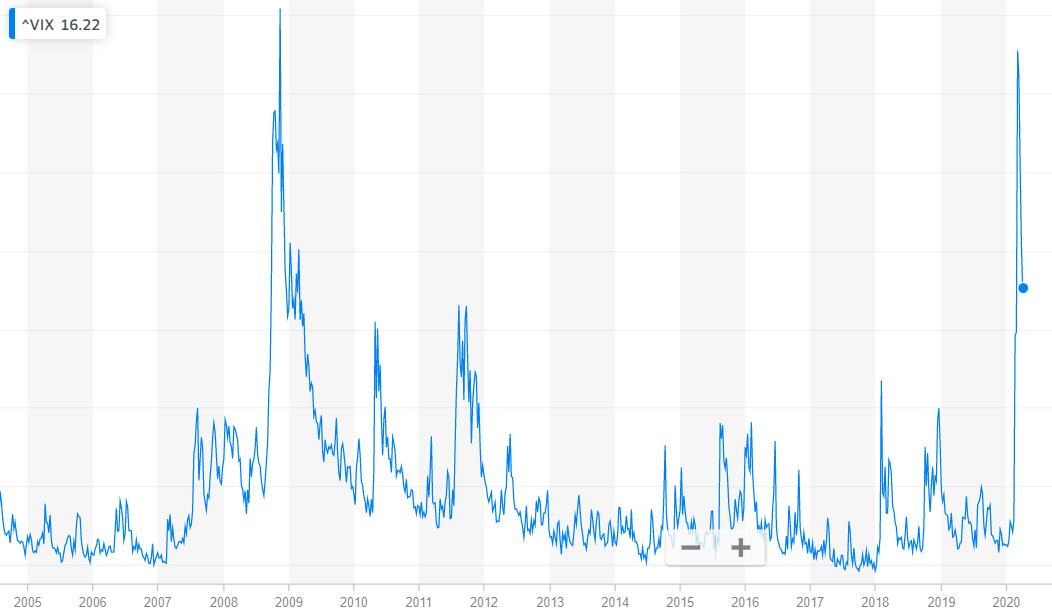
There are some interesting points to note. The Vix index or fear index spiked massively in March. The below chart shows a comparison between 2008 and March 2020, however it’s measured on a weekly basis and doesn’t quite do the most recent spike justice. On a daily basis, the index was actually higher than in 2008. Since March 17 it has dropped by half.

The All Ords have clawed back 15%, the S&P 500 is up 22%. All this while economies have shuttered, and millions are unemployed. It seems confusing, but markets don’t necessarily focus the now as much as they focus on the future. They are sensing there is a way out. There will be plenty of bad days ahead, but the restrictions seem to be working. With containment, will likely come ongoing testing and observation. You shouldn’t expect a return to normality for a while, but when it comes, it will come with pent up demand. There’s all of that stimulus to wash through. The urge to spend is unlikely to be suppressed in lock up and many people will have money landing in their accounts with significantly less opportunity to spend.

It should be noted that different hemispheres face different situations. Australia is heading into winter and we face challenges which may leave us under a higher level of restrictions than the Northern Hemisphere. That’s what six months of stimulus was for.

We remain optimistic, but this doesn’t mean there’s not the potential for more market turmoil. Millions will feel pain. Some of it will be self-inflicted. Those who thought debt was a replacement for savings and speculation a replacement for evidence. They will complain it’s unfair, but government won’t be bailing out everyone. This isn’t the end for society, democracy or capitalism. One thing will end: this pandemic.

Something to look forward to.

This represents general information only. Before making any financial or investment decisions, we recommend you consult a financial planner to take into account your personal investment objectives, financial situation and individual needs.

Filed Under: Uncategorized

March 20, 2020 by John Duncan

COVID – 19 Update

March 20, 2020

We’re deep in a global pandemic. The positive? Governments are responding.

Unprecedented times call for unprecedented measures. Interest rates to near zero. Governments putting money into bank accounts. Financial support for business. Government quickly realised the time for half measures was over. President Trump especially. He’s got an election to win at the end of the year. Previously he’d been coasting to victory. With the US economy pummeled, Trump’s no longer on a victory lap. Trump’s big stimulus may not be the last.

On an individual level, the important thing is getting through this. Physically and mentally healthy.

If you are feeling under stress that would be completely normal. If you’re feeling great that can be completely normal too. Various people will respond in various different ways. The important thing is decision making. We can help with clarity around decisions. Rarely are quality long-term decisions made when someone is feeling panicked or euphoric.

Optimism vs Pessimism

Feel free to watch this video before reading on.

It’s easy to look at these falls and conclude, ‘yes, they always come back.’ However, if we look at those charts, they’re absent something we’re being hit with right now. The narrative. The news. The story. The massive dose of uncertainty that was in the air. There was information swirling around all those occasions that led people to conclude it was time to get out. Just as there is right now.

If you can block out the noise surrounding the COVID-19 pandemic it will be much easier to be there for the recovery.

Will there be a recovery? It’s a very black and white scenario. Either we believe this gets better. Believe there will be a cure or a vaccine (the first live test has happened). The spread will eventually be contained. The recoveries will outpace new infections. Stimulus puts a floor under markets. Demand swells. Companies get back to business. Economies and markets come roaring back.

Or we don’t.

If we don’t, then there are much bigger problems than our portfolios or money. That’s a serious statement. The toilet paper wars haven’t shown humanity in its best light, but the best global medical minds are on the case. No one can seriously argue that a cure or vaccine won’t be found. That argument is a bet against all of humanity’s progress to this point. We’re leaning on the side of optimism. It hasn’t failed yet.

Reactions

A recovery will eventuate. The timing is uncertain. The economic impact is unknown.

This event is provoking various reactions.

The expected – some people are concerned about their portfolio; most are happy to wait it out.

The unexpected – some people are excited without considering broader implications.

Don’t panic. Don’t make impulsive changes. Stick to your plan. We reinforce these messages regularly. It stops investors harming themselves long term. It’s also beneficial to help people understand the benefits of rebalancing a portfolio after a fall. After market falls, expected returns increase. This can benefit investors in the recovery.

These messages are everywhere now. It’s good that investors have more clarity around market falls. Understanding they’re not fatal. In some ways, this has worked too well. Don’t make impulsive changes also can apply to buying as well as selling.

We’ve seen instances of investors broaching the idea of margin lending or pulling money from mortgages to take advantage of what they see as an unprecedented opportunity.

This is where good financial advice and a sober second opinion prove valuable. After a full analysis, it may be advantageous for the right investor with a long horizon. However. ‘Is this a good opportunity?’ needs to be accompanied by ‘how secure is my employment?’. Economic activity is stalling. Imagine taking on a bravado loan, seeing another sell off and losing a job if your house price declines.

There hasn’t been a glove laid on real estate yet, but Airbnb rental entrepreneurs now have no income. Open houses will go quiet. Auctions be postponed. International students who fill apartments are now tethered to their own country. While guidance from Real Estate Institutes in Australia has been slim, the British Columbia Association of realtors called this an “unprecedented paralysis of economic and social activity”. Jobs are tenuous in many industries. Maybe not the time to be dipping into home equity. A personal financial planning picture needs to be fully weighed against the lure of investment opportunity. Feeling negative or positive, the reference point before making any decision should be a discussion with your adviser about your goals and plan.

Timing the Market    

Superfunds are overwhelmed. People are bailing to cash. Visit any internet investment forum and you’ll see why. This isn’t a permanent decision. They’re intending to return when this all blows over. They concede they missed the sell off and have now crystallised a loss. But they apparently know when it will be time to get back in.

While the recovery will eventuate, the path to the recovery won’t be smooth. Bottoms are bottoms in hindsight. The bottom might come with a 20% positive month, followed by an 15% drop. Almost back to where things started. That might give someone second thoughts.

Three charts to highlight the folly of market timing. This is the US S&P 500 in the aftermath of the dotcom bubble and 9/11. This chart’s a monthly chart. The bottom appears evident. We’ve highlighted it with the green circle. There was another sell off, but if an investor managed to pick the bottom and hold their nerve, the rewards would flow. It all seems very clear.

Now the same chart, just on a weekly basis. It’s a little messier. Not just a straight up, down and up. Note another dip and recovery appears to the left of the circle (the true bottom), but it wasn’t quite the right point to re-enter.

Now on a daily basis. The movements are no longer smooth. A recovery that seemed very clear in the first chart is now filled with much more noise to navigate. Picking the bottom in October 2002 looked pretty smart until the sell off in January 2003 which lasted 6 weeks. It was nearly back to that first bottom again before the upward momentum stuck.

An investor jumping to cash creates a decision-making chain. When exactly do they feel safe? What signals do they use and what noise do they disregard? How do they successfully identify their re-entry point when there is no certainty around the bottom? There may be false starts before the recovery fully gathers a head of steam. How does someone not confident enough to sit tight find the confidence for their re-entry?

If you have any concerns, speak to us. No matter what impact this virus might have, it is always good to review your overall financial goals and objectives, and think about making them stronger. That’s the smart move in stressful times like these. We are all in this together, stay calm and stay healthy.

This represents general information only. Before making any financial or investment decisions, we recommend you consult a financial planner to take into account your personal investment objectives, financial situation and individual needs.

Filed Under: Uncategorized

  • « Previous Page
  • 1
  • 2
  • 3
  • 4
  • …
  • 9
  • Next Page »

Keep up to Date

Powered by VMA-Emailer

Meet John Duncan

John Duncan - Financial Planner

Director for True Financial - John Duncan - Fee Only financial planner To receive the best financial planning advice you need the best financial planner. John Duncan is certainly in that category. John is a financial planner who is unique in not only his high level of knowledge and experience in financial planning but also in the amount of areas that John advises in. A Financial Planner with a strong Education background John is a Certified … Read More

Post Categories

  • Budget (5)
  • General (27)
  • Insurance (2)
  • Investment (14)
  • Property (5)
  • Superannuation (4)
  • Tax Tips (7)
  • Uncategorized (50)

Like us on Facebook

Recent Posts

  • 2025 Q2 June Quarter Review
  • Don’t Vote with your Portfolio
  • Investing Has Been Solved
  • John Hussman: Man Who Predicted…
  • Bank Runs

Privacy Statement

See our Privacy Statement here

Keep up to Date

Powered by VMA-Emailer

True Financial is an Authorised Representative No. 428771 and Credit Representative No. 428873 of FYG Planners Pty Ltd, AFSL/ACL No. 224543. ABN 29 009 541 253

Contact Information: Address: 23 Errard St Kelvin Grove 4059 - Phone: (07) 3169 2570 - Email: admin@truefinancial.com.au - Web Design & SEO by: Visual Marketing

Information provided on this website is general in nature and does not constitute financial advice. True Financial Pty Ltd will endeavour to update the website as needed. However, information can change without notice and True Financial Pty Ltd does not guarantee the accuracy of information on the website, including information provided by third parties, at any particular time. Every effort has been made to ensure that the information provided is accurate. Individuals must not rely on this information to make a financial or investment decision. Before making any decision, we recommend you consult a financial planner to take into account your particular investment objectives, financial situation and individual needs.True Financial Pty Ltd does not give any warranty as to the accuracy, reliability or completeness of information which is contained in this website. Except insofar as any liability under statute cannot be excluded, True Financial Pty Ltd, its employees do not accept any liability for any error or omission on this web site or for any resulting loss or damage suffered by the recipient or any other person. Unless otherwise specified, copyright of information provided on this website is owned by True Financial Pty Ltd. You may not alter or modify this information in any way, including the removal of this copyright notice.
Manage Cookie Consent
To provide the best experiences, we use technologies like cookies to store and/or access device information. Consenting to these technologies will allow us to process data such as browsing behavior or unique IDs on this site. Not consenting or withdrawing consent, may adversely affect certain features and functions.
Functional Always active
The technical storage or access is strictly necessary for the legitimate purpose of enabling the use of a specific service explicitly requested by the subscriber or user, or for the sole purpose of carrying out the transmission of a communication over an electronic communications network.
Preferences
The technical storage or access is necessary for the legitimate purpose of storing preferences that are not requested by the subscriber or user.
Statistics
The technical storage or access that is used exclusively for statistical purposes. The technical storage or access that is used exclusively for anonymous statistical purposes. Without a subpoena, voluntary compliance on the part of your Internet Service Provider, or additional records from a third party, information stored or retrieved for this purpose alone cannot usually be used to identify you.
Marketing
The technical storage or access is required to create user profiles to send advertising, or to track the user on a website or across several websites for similar marketing purposes.
Manage options Manage services Manage {vendor_count} vendors Read more about these purposes
View preferences
{title} {title} {title}